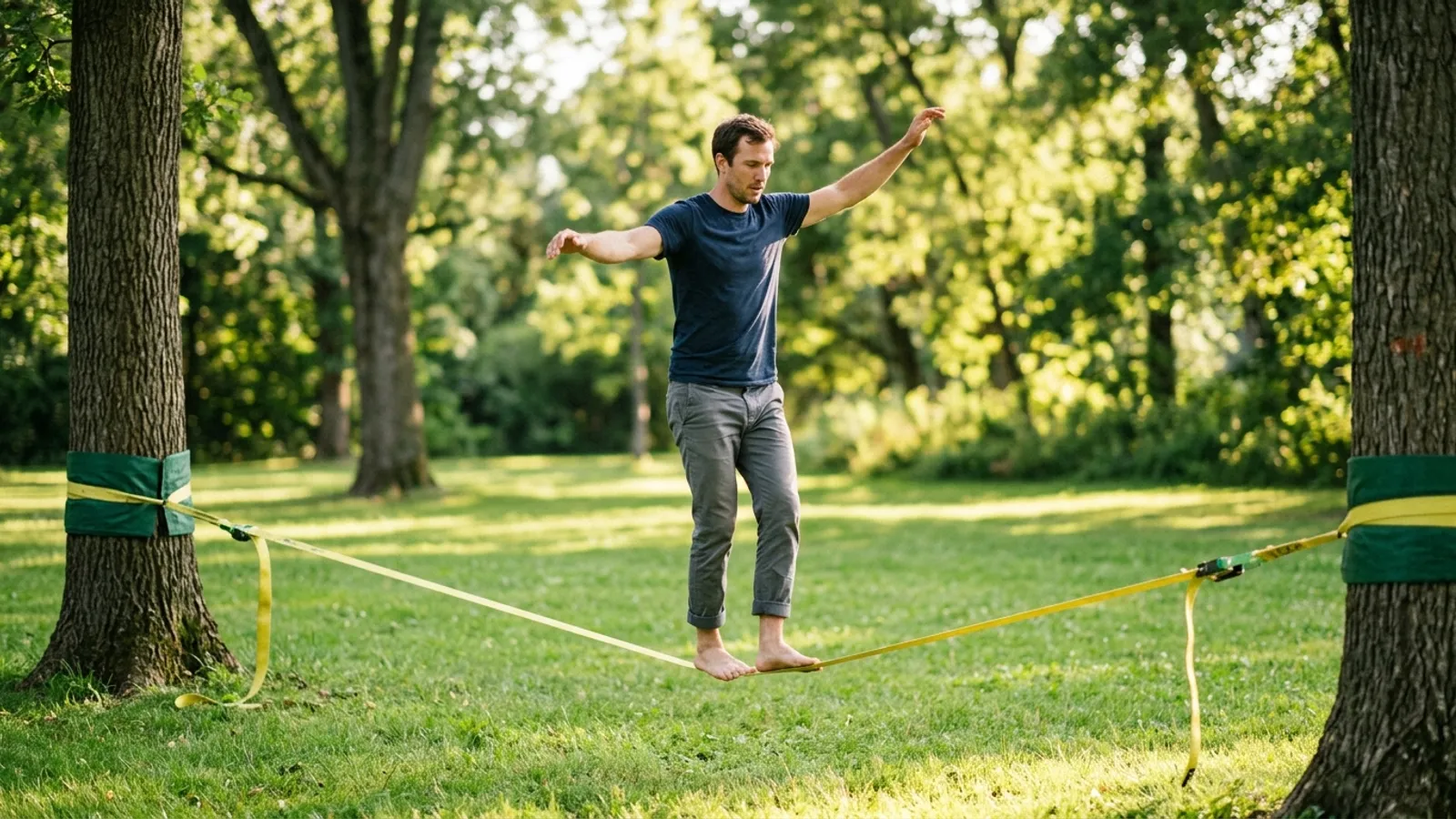
Slackline width: why it matters
When you buy a line, the slackline width is one of the first decisions you make – and it noticeably changes how the training feels. The two common sizes are 25 mm and 50 mm, so a narrow and a wide band. Both carry you with no trouble, but they behave completely differently underfoot.
In short: the width determines how calm or how lively the line feels. A wide band sits more solidly under the foot and reacts more sluggishly. A narrow band is more dynamic, springs more strongly and demands more finesse.
This has nothing to do with “better” or “worse.” It’s about your goals. Do you want to learn to stand securely, train balance and have fun in the garden? Or are you drawn to jumping, bouncing and practicing tricks? That’s exactly what this guide is about.
One thing up front: band width isn’t the only adjustment screw. Length, pre-tension and surface play a part too. But you feel the width with every single step – which is why it’s worth choosing it deliberately.
What actually happens underfoot?
When standing on a line you don’t just balance forward and back, but above all sideways. The narrow band tips to the side faster and swings more freely. The wide band offers your foot more contact area and “forgives” small wobbles more easily.
This sideways stability is the core of the whole thing. The more area your foot finds, the more easily you find that first calm stand – and the faster moments of success set in.
50 mm: stable for beginners
The 50 mm band is the classic for getting started, and for good reason. The greater width gives your foot more room, the contact feels more solid, and the line swings more calmly overall. For the first few weeks that’s a huge advantage.
Especially at the start you don’t want to fight against a fidgety line. You want to feel how balance feels, how your body counter-steers and how the first free stand succeeds. A wide band takes some of the unrest out of it for you.
For fitness training too, 50 mm is usually the better choice. Squats, lunges or calm standing with small weight shifts work more controlled on the wider surface. You can concentrate on the exercise rather than just wrestling with bare balance.
Who 50 mm is worth it for
- Beginners standing on a line for the first time.
- Families where children and adults use the same line.
- Fitness focus: balance, core stability, calm strength training.
- Casual slackers who just want fun in the garden.
If you fit into this group, you’re best served with a wide band. Discovering a well-thought-out beginner set with a 50 mm band brings you the ratchet and band protectors right along – so you start safely and without guesswork.
The small catch
50 mm isn’t entirely without compromise. The greater contact area can sometimes feel a bit “edgy” underfoot, especially barefoot and at higher pre-tension. Plus, a wide band springs less – anyone who later wants to jump quickly notices the limits.
For getting started and for fitness training, though, that hardly matters. These properties only become relevant once you’re thinking toward tricks.
25 mm: dynamic for tricks
The 25 mm band is the classic trickline width. It’s narrower, lighter and springs much more strongly. It’s exactly this liveliness that’s the reason ambitious slackers love it – and why beginners often despair of it.
A narrow band reacts to every little movement. It swings more, gives way more under pressure and returns energy on the takeoff. Anyone wanting to practice jumps, spins or sitting bounces needs exactly this springy behavior.
In longlining too – so long distances – narrower material often comes into play, because it’s lighter and tensions differently. For normal garden use that’s no issue, though; there it’s more about the trick properties.
Why 25 mm is more demanding
- Less contact area → the foot has to work more precisely.
- Stronger swinging → more corrections per second.
- More spring → great for jumps, restless for calm standing.
That doesn’t mean 25 mm is only for pros. It only means: the learning curve is steeper. If you bring patience along and the dynamic feel appeals to you, you can start narrow straight away – you’ll just need a bit more staying power.
If the topic tingles for you, take a look at our first tricks. There you’ll see which movements benefit especially from the springy band and how to build them cleanly.
Hybrids and special cases
There are also bands in between, or special weaves that spring a little less. For the basic decision, though, it’s enough to think of the two poles: 50 mm = calm and stable, 25 mm = dynamic and springy. Everything else lies somewhere on that line.
Which width suits you?
Now to the practice. The answer depends almost entirely on your goal – not on body size or weight, as is often assumed.
Are you a beginner or training balance and core? Take 50 mm. The calmer stand brings you success moments faster, and that’s exactly what keeps you at it. For the vast majority of people the wide band is the right first choice.
Are you drawn to tricks, jumps and the springy feel? Then 25 mm is your band – knowing that the start gets tougher. Anyone working toward jumping from the very beginning saves themselves the later switch.
Are you undecided? Start wide. You learn to stand more cleanly on 50 mm, build a stable foundation and can add a narrow trickline at any time later. Many slackers end up owning both anyway.
What else counts in the choice
When buying, look not just at the width but at overall quality: a clean ratchet, robust seams and band protectors for the trees. The DIN 79400 standard serves as your guide for safety-tested slackline material.
Don’t have two suitable trees in the garden? Then the width is secondary – more important is a stable setup. Looking at a slackline frame for the tree-free setup makes you independent of location and season, indoors and out.
If you want to go deeper into the buying decision, our buying guide for beginners helps you with length, set scope and accessories. That way you make a choice that really suits your everyday life.
Want to compare directly what’s out there? Then you can browse the Primeful shop at your leisure and look at sets, frames and accessories side by side.
The short rule of thumb
If you only want to remember one sentence: wide for stable learning and fitness, narrow for springy tricks. With that you make the right decision in nine out of ten cases – and can then concentrate on practicing rather than pondering.
Frequently asked questions
Is 25 mm too hard for beginners?
It’s not too hard, but clearly more demanding. The narrow band springs and swings more strongly, so you have to correct more at the start. If you have patience and tricks in mind anyway, you can start with it – otherwise you learn more pleasantly on 50 mm.
Does the slackline width make a difference for strength training?
Yes, noticeably. On the wider 50 mm band you have more contact area and can perform squats or lunges more controlled. The narrow band steers you more toward pure balance, which during calm strength training tends to hinder rather than help.
Which width is best for tricks?
For jumps, bounces and spins the narrow 25 mm band is the usual choice, because it springs more strongly and returns energy. This dynamic is exactly what makes tricks possible in the first place. On a wide band you lack this effect.
Can I later switch from 50 mm to 25 mm?
Sure, and that’s exactly what many do. You build a secure foundation on the wide band and add a narrow trickline later, once you fancy more dynamics. Having both bands at home is completely normal and sensible.