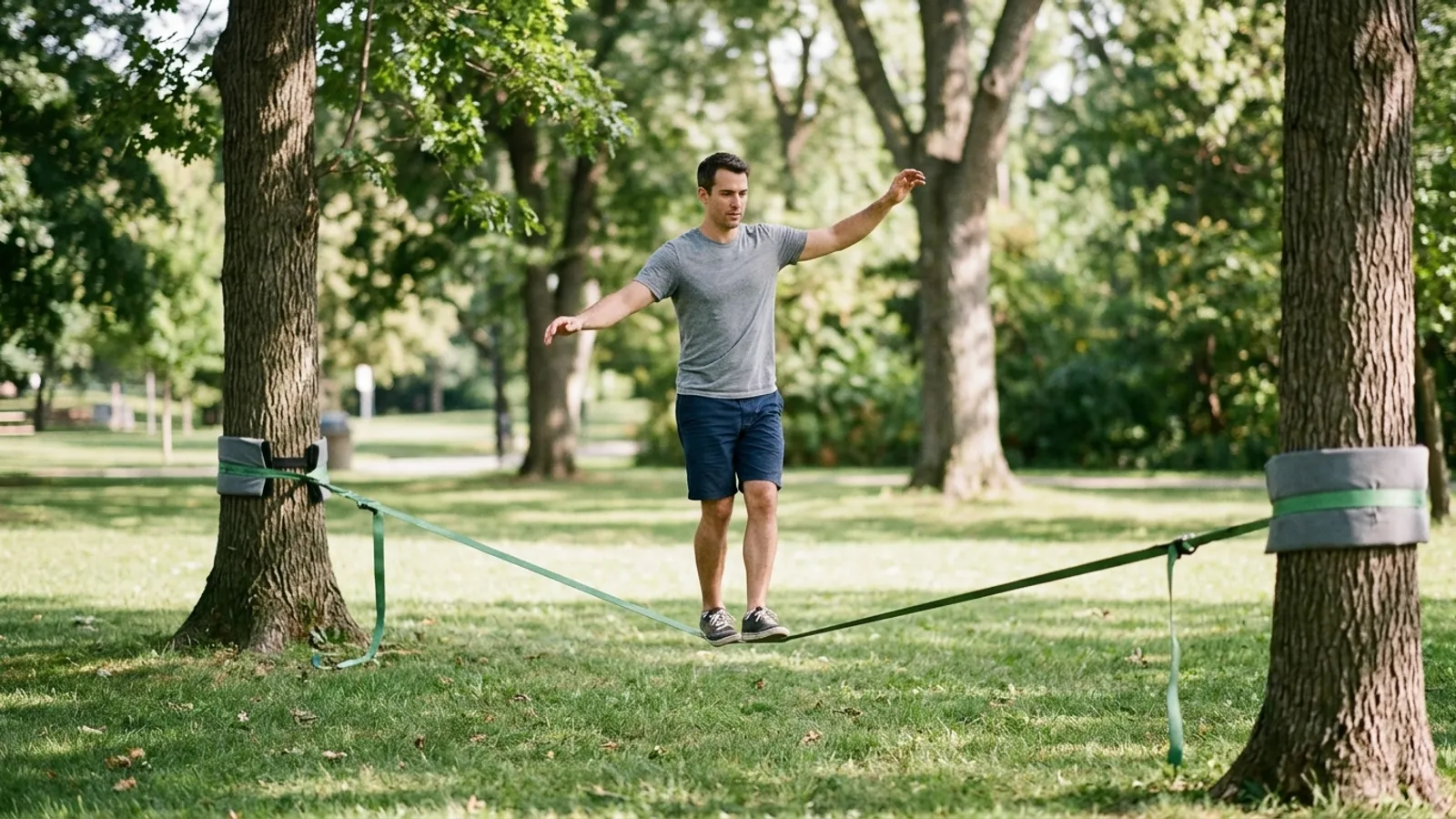
The best slackline for beginners, and what really fits
The question of which is the best slackline for beginners sounds trivial at first – until you stand in front of the shelf or the online shop and suddenly widths, lengths, ratchets and terms like “trickline” come at you. Don’t worry, it’s simpler than it looks.
The core in one sentence: you want a wide, fairly long and easygoing line with a reliable ratchet – not a taut sports device for jumps. That’s exactly what takes the wobble out of your legs at the start and delivers quick wins.
In this guide we go through the four points that really count: length, width, ratchet and set contents. By the end you’ll know what to look for when buying – and why a complete beginner set almost always pays off more than a single band.
What matters at the start
As a beginner, you mainly need a forgiving setup. A line that sags a little and isn’t tensioned rock-hard gives you time to react. That’s exactly what you want when you’re just learning to find your balance.
What you don’t need: maximum tension, narrow bands or pro accessories. That comes later all by itself, if the sport grabs you. The step-by-step process for your first setup is shown in our setup tutorial.
Length and width
Length and width decide more about your first weeks than any other detail. Both values work together: they determine how calmly the line sits and how much it sways under your feet.
Which length makes sense?
For the start, a band of around 15 meters is a good rule of thumb. That sounds like a lot, but it gives you room: you don’t have to tension the line over its full length and can adjust the usable distance depending on the spacing of your anchor points.
What matters is the free distance between the anchor points. For your first steps, around three to five meters is plenty – shorter is actually easier, because the line then sways less. A long band grows with you when you later want more distance.
Narrow or wide?
Here the clear recommendation for beginners is: wide. A line with 50 mm sits more calmly under the foot and sways sideways less than a narrow 25 mm trickline. That makes the first attempts noticeably more relaxed.
Narrow 25 mm bands are intended more for tricks and jumps – they react more nervously and demand more control. As a beginner you benefit from the wider variant. We dig into the differences behind this in 25 mm or 50 mm.
Ratchet, tree protectors and set
Once length and width are right, it’s on to the components that make everyday use pleasant. This is where solid equipment separates itself from frustration during setup and takedown.
The ratchet – the heart of it
The ratchet tensions your line and holds the tension. It should be solidly built, grip cleanly and open easily without your fingers getting in the way. A wobbly cheap ratchet is exactly the spot where budget sets annoy you later.
Look for a sturdy lever and a clear locking mechanism. As a guide for tested quality, you can rely on the DIN 79400 standard for slacklines – it describes requirements for material and safety.
Also practical is a lever that leaves enough room for your whole hand. After all, when tensioning you pull the line to body tension, and a lever that’s easy to grip makes that much more pleasant. A ratchet with a safety latch that prevents accidental release adds extra peace of mind.
Tree protectors are part of it
If you tension between two trees, tree protectors are a must. They protect the bark from the band cutting in and are even required in many parks. A good beginner set brings them along directly.
Without protectors you damage the tree and risk the line slipping. A few wide protective pads solve the problem completely – a small part with a big effect.
Complete set instead of a single band
A single band seems cheap, but often leaves you missing a ratchet or without protectors. A coordinated set saves you the search for matching individual parts and ensures everything fits together.
For an uncomplicated start, we therefore recommend a complete package. If you want to get going right away, you can take a look at a complete beginner set with ratchet and tree protectors – band, tensioning system and protection in one delivery.
How to recognize a good beginner set
- Band around 50 mm wide for a calm stand
- Length of around 15 meters, so you tension flexibly
- Sturdy ratchet with a strong lever
- Tree protectors included, not as an expensive extra
- Clear instructions for the first setup
With a tree or with a frame?
Before you buy, settle one question: where do you actually want to slack? That decides whether the classic band is enough or whether you need more.
When trees are available
If you have two stable trees at the right spacing, it’s simple. Look for healthy trunks with enough girth, put the tree protectors in place and tension the line. That’s the cheapest and fastest way in.
Check beforehand that the ground is level and free of stones or hard edges. That way you land soft if it comes to it – and at the start that happens often.
As a rough guide, a tree should be at least knee-thick so it carries the load safely. Don’t tension the line too high: about hip height is enough, then you reach the ground with your feet and mount calmly. If the tree wobbles a lot or the bark is loose, better find another one.
When there are no trees
No tree, no problem: there are slackline frames with ground anchoring for that. They work on the lawn, in the garden or – depending on the model – indoors too, and free you from the need for the right tree spacing.
For regular training in particular this is practical, because you don’t depend on the weather or the right location. If you want to train without trees, it’s worth a look at a slackline with a stable frame for garden and indoors. That turns the fair-weather idea into a year-round workout.
Weighed up briefly
The tree version is cheaper and quicker to get going, but needs the right trees. The frame costs more and is more flexible – ideal if you want to practice permanently and independent of location. Both are beginner-friendly; the only deciding factor is your location.
If you’re still undecided and want to compare, you can take your time to browse the Primeful shop and look at sets side by side before you commit.
Frequently Asked Questions
How long should my first slackline be?
A band of around 15 meters is a good all-rounder. You don’t necessarily tension it fully, but adjust the free distance to your anchor points. For your first steps, three to five meters of free distance is enough, because the line then sits more calmly.
Wide line or narrow trickline for the start?
For beginners, a wide 50 mm line is the better choice. It sways sideways less and gives you more standing surface. Narrow 25 mm bands are intended for tricks and jumps and react much more nervously.
Is a complete set worth it or is the band alone enough?
A coordinated set is worth it almost always. You get the band, ratchet and tree protectors in one delivery and don’t have to buy anything separately. A cheap single band often turns out more expensive, because accessories are missing.
What if I don’t have a tree to tension between?
Then a slackline frame with ground anchoring is the solution. It works on the lawn and, depending on the model, indoors too, so you train independent of tree spacing. That makes regular practice easier throughout the year.