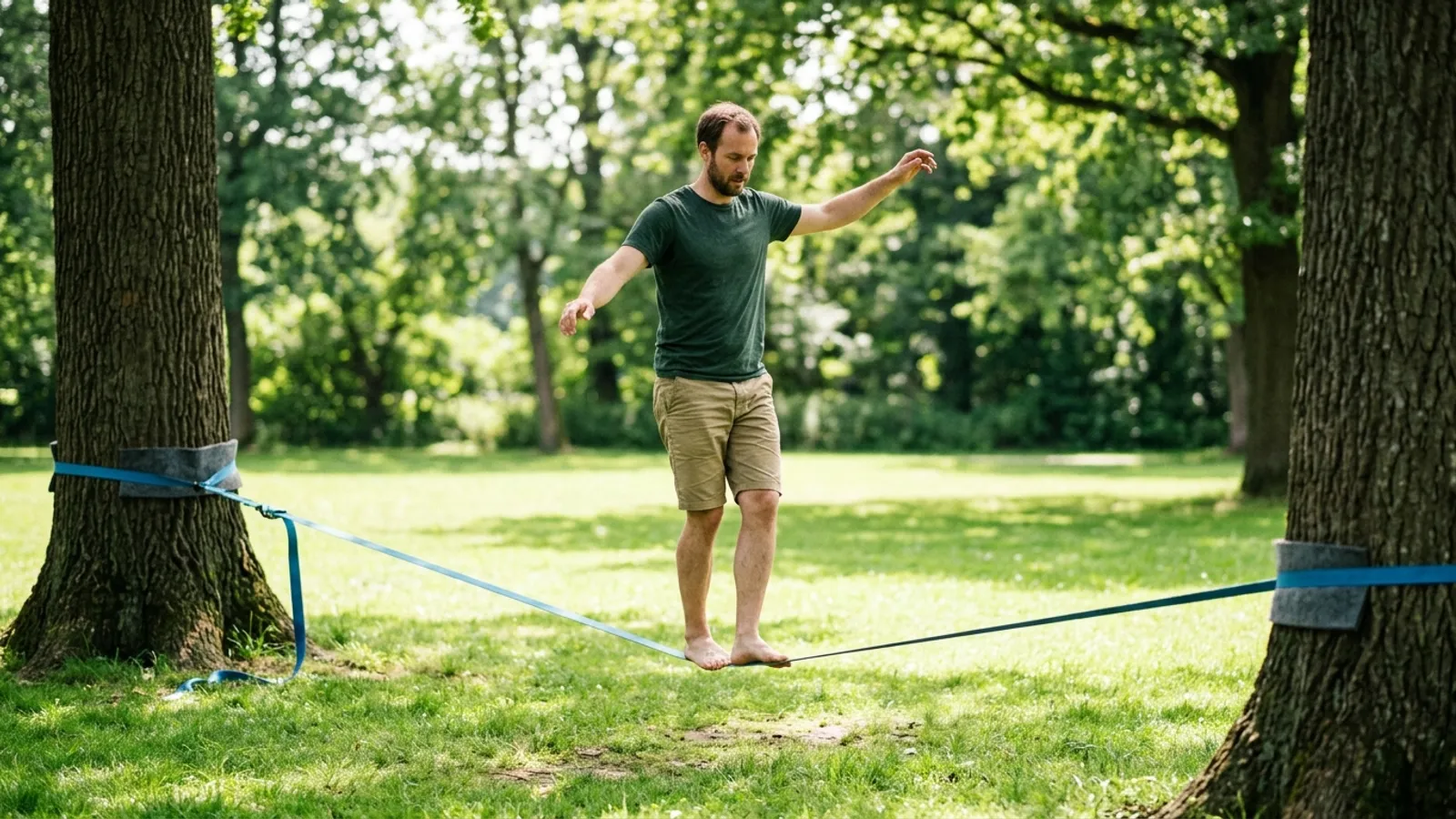
When it gets dark early and the garden is frozen solid, a lot of people think: now it’s time for a break. But giving up your slackline in winter costs you exactly the balance and core strength you built up over the summer. The good news: you don’t have to stand outside in the cold to stay consistent. With the right setup, you simply move your training indoors – and keep training normally right through the cold months.
In this post I’ll show you why the winter break is usually unnecessary, what an indoor setup with a frame looks like, which short routines fit into small spaces, and how to stay motivated during the dark season.
Slackline in Winter: Does the Line Have to Go in the Cellar?
The short answer: no, it can go in the cellar – but to train on, not to store. Balance and deep muscles aren’t summer skills. They respond to regular stimulus, and you can deliver that all year round.
The real problem in winter is rarely the cold itself. It’s the gap in your setup: outside you need two trees or solid anchors, the ground is hard or slippery, and after work it’s already dark anyway. This is exactly where most plans fall apart – not for lack of willpower, but for lack of opportunity.
What you lose by taking a break only becomes obvious in spring. Proprioception – your sense of where your body is in space – noticeably declines when it isn’t used. Anyone who sits out for several months often starts almost from scratch again in March. That’s frustrating and avoidable.
Then there’s the habit effect. A routine you interrupt in autumn has to be rebuilt in spring. It’s far easier to carry an existing habit through the winter than to restart it twice a year. That alone makes an indoor plan worth it.
And there’s a side effect many underestimate: in winter we move less overall. Walks get shorter, the sports field is muddy, the couch is tempting. A few minutes on the line don’t just maintain your balance – they get you off your seat in the first place. That often does more against the winter slump than against muscle loss.
The Indoor Setup with a Frame
The key to winter training is being independent of trees. Indoors you have none, and you don’t want to drill into the wall either. The solution is a freestanding frame that absorbs the tension itself. You need no anchoring, no fastening, no suitable distance between trees – just a bit of space.
Where Does It Fit?
A frame is surprisingly flexible in a room. These have proven their worth:
- Living room: push the sofa and table aside, and you’ve got a short training stretch. Put everything back after your session.
- Cellar or hobby room: ideal, because you don’t have to move anything and you can leave the line set up.
- Garage: often the underrated favorite – enough length, a sturdy floor, no one to disturb you.
Plan roughly for the length of the frame plus a bit of room to move on the sides. A low tensioning height is enough for most exercises, and you’re closer to the floor, which is a nice safety plus indoors. Also pay attention to the height of the room: when you raise your arms overhead in a standing position, nothing should be in the way – lamps, low ceilings or shelf boards quickly become an annoyance otherwise.
A practical advantage of the frame: you can move it whenever you need to. Today in the living room, on the weekend into the garage, in summer back out onto the terrace. This mobility takes away the decision of having to sacrifice a fixed spot.
What to Watch for During Setup
Place the frame on a level surface and give it clear space all around – away from sharp edges, shelves and glass. An exercise mat or a thick rug underneath cushions small slips and protects the floor at the same time.
When it comes to equipment quality, it’s worth looking at solid construction and clear load ratings. The German slackline standard DIN 79400 can serve as a reference when you compare materials. It’s not a must, but a helpful pointer for stability.
If you don’t yet have a floor-independent setup, this is the decisive building block for winter: with a slackline with a frame, you can keep training without a tree right in the middle of your living room. For more on choosing and setting one up, see the detailed post on the slackline frame.
Short Routines for Indoors
Indoors the stretch is shorter than in the park – and that’s not a drawback. For balance and core training you don’t need ten meters. You need clean repetitions and a bit of focus. Short sessions of ten to fifteen minutes are plenty to set the stimulus.
Routine 1: The Stand Wake-Up (about 8 minutes)
Perfect for getting started or as a short break in between.
- Single-leg stand: step up, find the middle with one foot, hold as long as you can. Look forward at a fixed point, not at your feet. 3 to 5 attempts per leg.
- Two-leg hold: both feet lengthwise on the line, knees slightly bent, arms loosely raised. Breathe calmly and hold the position.
- Shift your weight: from a secure stand, slowly move your weight from one leg to the other without stepping off.
Routine 2: Core and Legs (about 12 minutes)
Once you stand securely, you bring strength into play.
- Squat on the line: from the two-leg stand, slowly drop into a squat and back up. Start small, keep the tempo low, deliberately engage your core.
- Lunge hold: one foot forward, one foot back on the line, stabilize the position briefly. This strongly challenges the lateral core muscles.
- Seated balance: sit across the line, lift your feet briefly and find your balance. An underrated core exercise.
Routine 3: The 5-Minute Stimulus
On busy days, the minimum is enough. Stand cleanly on one leg three times, balance across the stretch once, done. Better short and regular than rare and long – consistency beats volume.
Feel free to step off and back on between exercises. Indoors it’s not about putting on a show, but about repeated, controlled movement. If you’re brand new, you’ll find a complete overview in the slackline fitness guide.
Staying Consistent in the Cold Season
The biggest hurdle in winter isn’t the training, it’s the start. When it’s dark and cold, the threshold to procrastinate drops. A few simple tricks help you get on the line regularly anyway.
Make it visible. A line set up in the cellar or garage is a constant invitation. What’s in sight gets used – what’s in the cupboard gets forgotten. That’s exactly the underrated advantage of a fixed indoor spot.
Tie it to a habit. Three minutes of balancing right after work, before dinner, or while your favorite show is on. That way training doesn’t need its own act of willpower, but hangs onto something you do anyway.
Lower the bar. Don’t set yourself a big goal, but a ridiculously small one: get on the line once. Most of the time you’ll stay longer. And on days when it really is just that one time, you’ve kept the habit alive anyway.
Keep it warm and pleasant. Indoors the cold factor disappears, the one that’s so often the knockout argument outside. Barefoot on the line at room temperature, calm music, no wind – it makes practicing almost cozy.
Make it a duo. When your partner, housemates or family join in, a duty turns into a little game. Who holds the single-leg stand longer? Such mini-competitions carry you surprisingly well through February.
The reward shows up in spring. While others start over from scratch, you pick up seamlessly where your summer level left off – and notice that the effort over winter paid off. If you still want to complete your setup, you’ll find matching lines and accessories in the Primeful shop. For beginners, a complete beginner set is also helpful so you’re ready to go right away.
Frequently Asked Questions
How much space do I need indoors?
A freestanding frame needs roughly its own length plus a bit of room to move on the sides. In most living rooms, cellars or garages you can set that up, often just by briefly pushing furniture aside. A mat underneath protects the floor and your joints.
Is slacklining indoors just as effective as outdoors?
For balance and core training, yes. The shorter stretch barely matters, because what counts is controlled repetitions, not distance. Indoors you even lose wind and cold, which often makes clean practice easier.
Do I really need a frame, or is a normal line enough?
Indoors you need a frame or a comparably floor-independent solution, because you lack trees and secure anchors. Drilling into the wall is usually not a good idea. The frame absorbs the tension itself and makes winter training possible in the first place.
How often should I train in winter?
Better short and regular than rare and long. Three to four short sessions a week of ten to fifteen minutes keep balance and deep muscles in good shape. Even five minutes on a busy day are better than a skipped week.