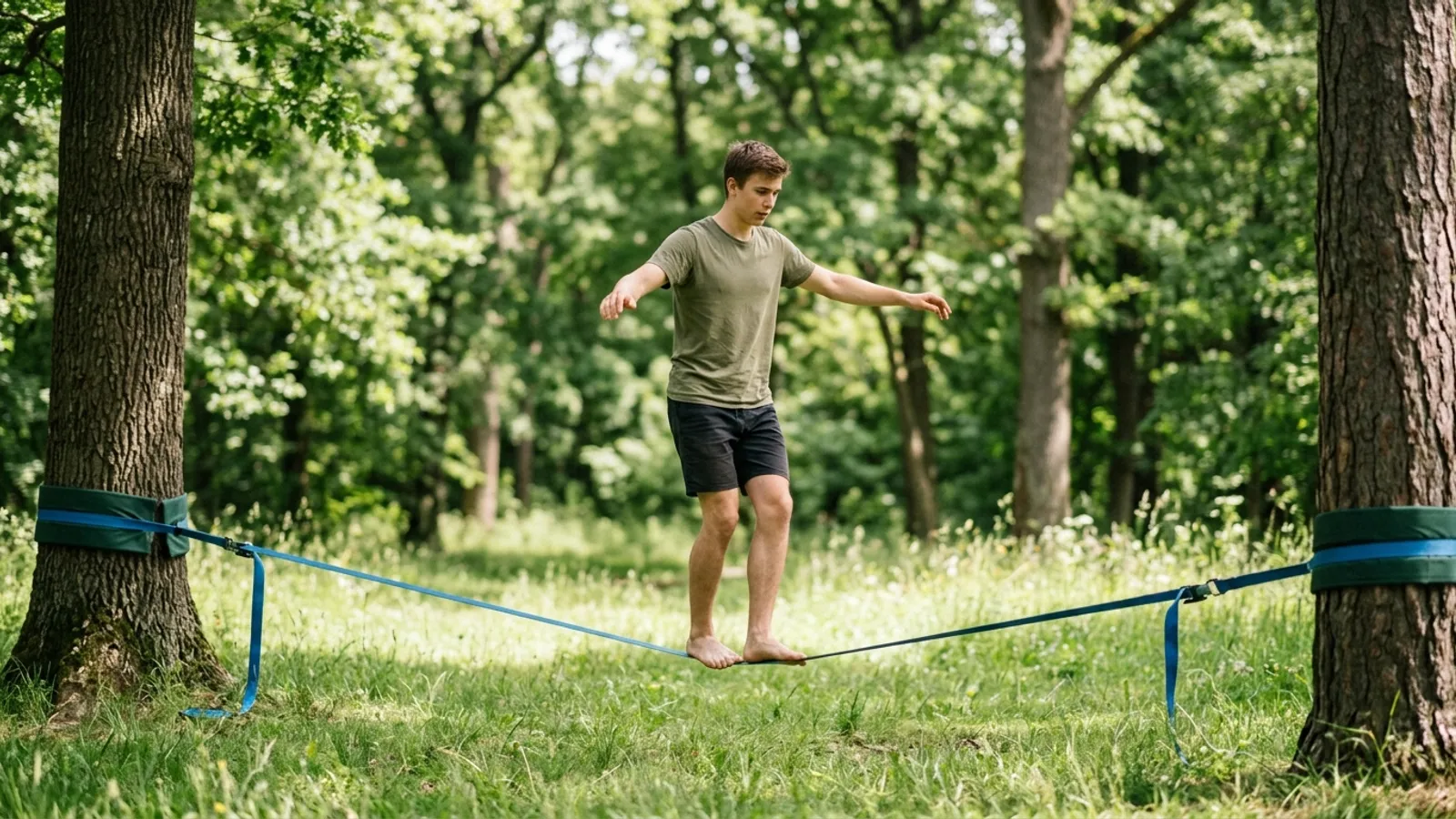
Slackline accessories: the most important things first
When it comes to slackline accessories, you’ll quickly be buried under lists: tree protectors, ratchet, training line, bag, padding, A-frames. That sounds like a lot of money, but it isn’t – if you know what really counts.
The honest truth: to get started you need surprisingly little. A good complete set already covers the real essentials. The rest is nice, but no must.
In this overview we separate must-haves from nice-to-haves – and show you where you can comfortably save. The goal is for you to start safely and relaxed, without spending your budget on things that end up unused in the cellar.
One thing up front: more gear doesn’t make you better faster. You learn balance through repetition, not through a full accessory box. Anyone who starts with the bare essentials practices more relaxed and notices on their own what they later really lack.
If you don’t have a line at all yet, first read briefly about which slackline suits beginners. Then the accessory question makes much more sense.
Must-haves for any setup
There’s a small handful of things you shouldn’t start without. They provide safety, protect your surroundings and make tensioning possible in the first place.
Tree protectors
If you tension between two trees, tree protectors are mandatory. The tension of a slackline presses on the bark with considerable force – without protection the band scrubs the bark open and damages the tree permanently.
A tree protector is a padded sleeve that spreads the band out widely and spares the bark. Good models are robustly stitched and don’t slip away under load. Make sure they’re wide enough for the trunk’s circumference.
Rule of thumb: the thinner the tree, the more important the protector – young trunks take damage faster. With very narrow trees you’re better off finding a stronger fixed point rather than piling on more padding. A healthy, mature tree at least roughly thigh-thick is the safe standard.
This isn’t an optional extra but basic equipment – even in your own garden. Trees don’t recover quickly, and in many parks slacklining without protection is simply forbidden. It’s worth browsing tree protectors and accessories in the Primeful shop before you tension up for the first time.
A reliable ratchet
The ratchet is the heart of your setup. With it you bring the band up to the necessary tension and hold it securely. A wobbly or cheap ratchet is no fun, but a safety risk.
What to look for:
- A stable mechanism with a cleanly gripping pawl that doesn’t slip through.
- Protected fingers: A grip guard prevents you from pinching your fingers when releasing.
- Matched to the band width: 50 mm bands need a different ratchet than narrow 25 mm lines.
For wide beginner bands a long-lever ratchet is pleasant, because you tension with less effort. More important than any number on the packaging is that the mechanism clicks in cleanly and releases again in a controlled way – jerky, snapping cheap ratchets are the most common source of injury during setup.
The good news: in a proper beginner set the ratchet is already included and matched to the band. So you don’t have to hunt it down separately. You’ll find a complete starter set with band, ratchet and protectors here – so you have the essentials in one go.
Soft, clear ground
This isn’t a product, but the most important “accessory” of all: a safe spot. Tension over a lawn, soft forest floor or sand – never over asphalt, concrete, stones or roots.
Keep the area under and next to the line clear of hard objects. At a low band height (knee to hip height) falls are harmless, as long as the ground plays along. More on that in our setup guide.
Indoors or on hard ground, a simple exercise or fall-protection mat does good service. It costs little, catches the first wobbles and takes away the fear of stepping back down – especially when practicing squats or push-ups over the line.
Nice-to-haves
Now come the things that make training more pleasant but don’t decide success or failure. Buy them once you’ve noticed you really need them – not as a stockpile.
Training line
A training line is a second, thin line that you tension at head height above the slackline. You can hold onto it during your first stand until your balance settles.
For absolute beginners practicing alone, this can reduce the frustration in the first few hours. But: many learn just as well by putting one hand on a second person’s shoulder or holding onto a branch.
So the training line is comfortable but rarely essential. If you want one, make sure it has a separate, stable fixed point – never hang it on the slackline trees at full height.
Padding and edge protection
Additional padding for the band’s start or corner protection on railings and posts makes sense if your setup has sharp edges. They protect both the band and the anchor points.
In the classic tree-to-tree setup with good tree protectors you usually don’t need this. With indoor frames or fixed anchor points, padding can extend the lifespan of your band.
Storage bag
A bag keeps the band, ratchet and protectors together and dry. Handy if you transport the line often or take it to the park – otherwise everything tangles up and the ratchet rusts faster.
Many sets include a simple bag right away. It’s not a must, but it saves you hassle and extends the durability of your equipment. Anyone looking for more options can discover useful accessories for slacklining once the basics are in place.
Slackline gloves
Gloves are a pure comfort question. Anyone with sensitive hands while tensioning, or who operates the ratchet often, appreciates them. For balancing itself they play no role – you don’t need them to make progress.
Ground anchors and A-frames
If you don’t have a second tree, ground anchors or a frame come into play. With them you can set up in the garden or indoors too, where trees are missing. This isn’t beginner accessory in the classic sense, but a different setup method – and it solves a real problem when your location doesn’t offer two suitable trees. For pure beginner training between two trees you don’t need it.
Do you really need this?
Here’s the honest breakdown so you don’t buy too much. Most beginners are well served with less than the advertising suggests. Ask yourself honestly with each item: does it solve a problem I already have today – or only one I might get at some point?
What you really need:
- A slackline band in a suitable width
- A reliable ratchet with grip guard
- Tree protectors for the tree setup
- A soft, clear surface
These four points are in every solid complete set – you don’t have to put anything together piece by piece. When buying, look for a quality reference like the DIN 79400 standard, which describes requirements for slacklines in the leisure sector.
What’s nice, but optional: training line, padding, bag, gloves. Buy them as needed, not out of fear of missing something.
What you can skip at the start: longline tensioning sets, tricklines with extra bounce and added weights. These are tools for specific goals – for balance, core training and first steps you don’t need them. A frame is the exception: not a luxury, but the solution when you simply lack the second tree.
My advice as a coach: start lean. Get a good set, practice for a few weeks, and add specifically what you concretely lack. That way you only spend money on things you actually use – and not on a full box of unused stuff.
A second benefit: anyone who starts with the set has all the parts matched to each other. You don’t have to check whether your ratchet fits the band width or the protector is wide enough – that’s already solved with a complete set. It saves time, research and wrong purchases.
If you do then want to expand, you can add specifically at any time. The basics stay the same, no matter how ambitious you become later.
Frequently asked questions
Do I really need tree protectors?
Yes, when tensioning between trees they’re mandatory. They protect the bark from the high tension force and prevent permanent damage to the trunk. In many parks slacklining without protectors isn’t allowed anyway – and in your own garden the tree will thank you.
Is a training line worth it for beginners?
It can make the first attempts easier, but it’s no must. Many learn just as quickly with a hand on a shoulder or on a branch. Try it first without – if you then need more support, you can always add one.
Is a complete set enough or do I have to buy accessories separately?
For getting started a good complete set is completely enough. Band, ratchet and tree protectors are matched to each other in it, and you spare yourself the search for fitting individual parts. You add optional accessories later, specifically as needed.
What’s the most important slackline equipment for beginners?
A reliable band with a matching ratchet, tree protectors and a soft surface – nothing more is needed. This basic equipment fully covers safety and function. Everything else is comfort, not foundation.