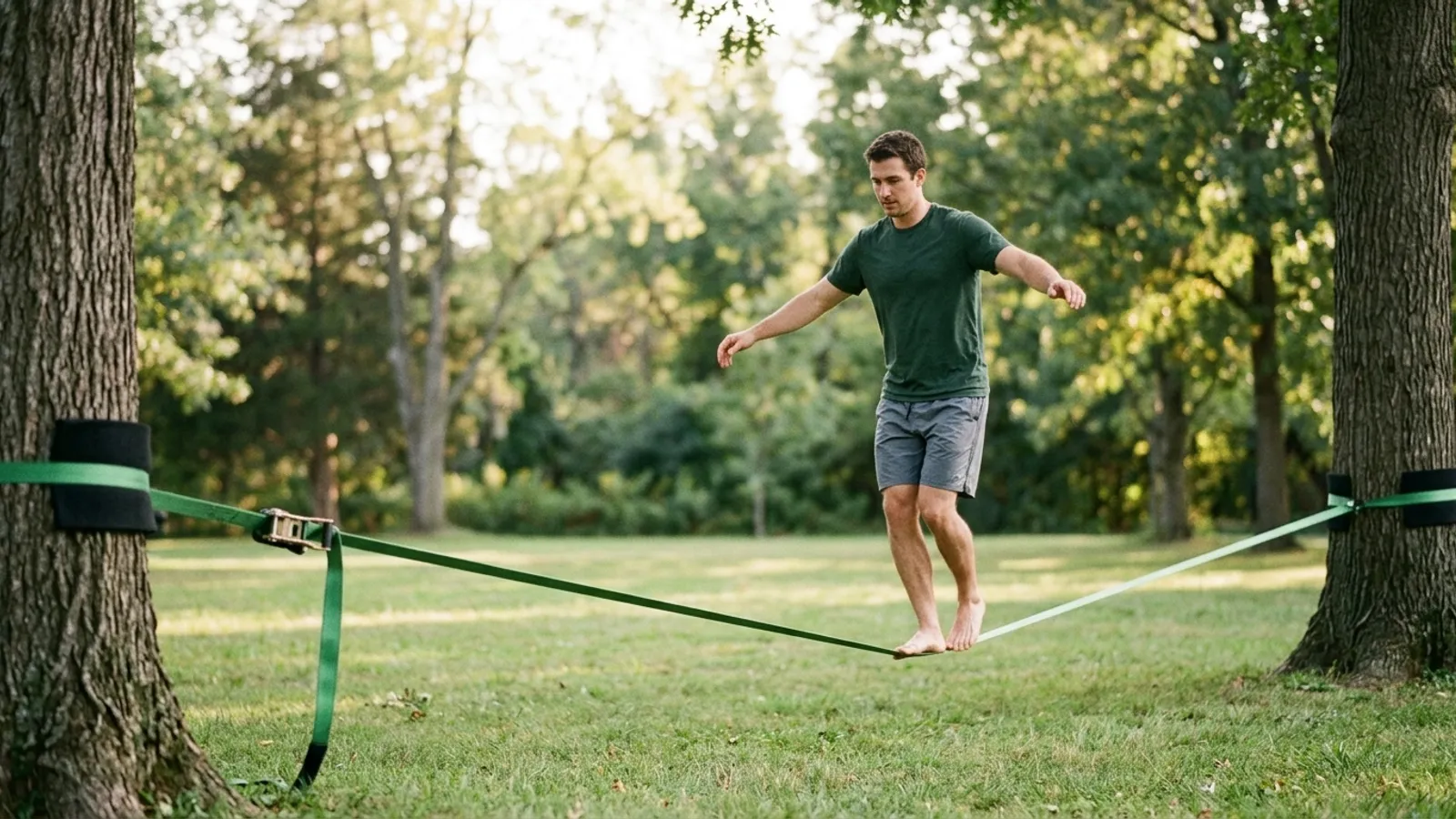
When you take time for a slackline warm-up, you don’t step onto a wobbly line cold, but with awake joints and a clear head. That makes every step safer and more stable. That’s exactly what this is about: a short, honest routine that you can run through in five minutes.
You don’t need any equipment or a pro plan for it. A bit of space, your line and some attention are enough. This routine works in the garden just as well as in the living room on a frame.
Why warming up before the slackline matters
The slackline challenges your body differently than most sports. Instead of solid ground, you have a moving surface that constantly gives way. Your body has to compensate for these micro-movements in real time.
For this, your feet, ankles and the deep core muscles mainly work together. They react through small corrections that you don’t consciously control at all. These reactions run faster and cleaner when the muscles involved are already warm and activated.
Stepping onto the line cold means: the joints are still stiff, the muscles react sluggishly, and your sense of balance isn’t in the game yet. You tense up more easily, tip over faster and quit in frustration. A good warm-up reverses that.
It’s not just about injury protection, even though warm ankles make small twists less frequent. It’s just as much about quality: anyone who starts warmed up finds a calm, controlled stance faster. That’s the most important building block for clean practice.
Another point is often underestimated: while slacklining, you easily lose patience when the first attempt goes wrong right away. A warmed-up body delivers small successes sooner, and those are exactly what keep you at it. That turns a frustrating session into one you look forward to.
Picture the warm-up as a gentle ramp-up. One after another, you wake the systems you’ll need on the line shortly: mobility, muscle activation and concentration. Only then do you step on.
As an adult in particular, you often sit a lot during the day; your hips and ankles are then rather stiff. A short mobilization compensates for that and makes the difference between a sluggish start and an easy entry. You don’t have to be able to do anything complicated for it, just consciously take a few minutes.
Slackline warm-up: the 5-minute routine
This routine is deliberately short. It covers the areas that work hardest while slacklining: ankles, hips, spine and core. Go through the exercises slowly and in a controlled way, rather clean than fast.
Plan about one minute per block. Keep breathing calmly and don’t hold your breath anywhere.
1. Mobilize the ankles
The ankles are your direct contact to the line, which is why we start here.
- Stand hip-width and roll alternately over the balls and heels of your feet, about ten times per side.
- Then circle each foot loosely in both directions, five circles each.
- To finish, a small calf stretch: one leg back, heel toward the floor, hold briefly.
Form cue: stay upright and let the movement come from the joint, not from the whole leg.
2. Open the hips and legs
A mobile hip gives you room to catch sways instead of wobbling in your upper body.
- Do eight to ten loose leg swings per side, first front and back, then sideways.
- Sink into a few slow, deep squats, five to eight depending on how you feel.
- Hold a deep lunge briefly in between, a few breaths per side.
Form cue: knees point over the toes, the upper body stays long and calm.
3. Loosen the spine and shoulders
On the line you also balance via your arms and upper body. Loose helps more than tense.
- Circle your shoulders big toward the back, about eight times.
- Do a few gentle standing rotations: arms loose, upper body turning from side to side.
- Roll your spine down and back up once slowly, without momentum.
Form cue: keep the movements flowing, no jerking, no abrupt turns.
4. Activate the core
Now you wake up the deep center that stabilizes you on the line.
- Hold a short forearm plank, twenty to thirty seconds, belly firm.
- Add a few slow standing scales: stretch one leg back, upper body leaning slightly forward.
- Consciously feel how your center works as you do this.
Form cue: the pelvis stays stable, no hollow back. Rather short and clean than long and sagging.
These four blocks are your standard program. If your legs are shaking or your stance wobbles, small adjustments to the setup often help more than more training. How to avoid typical stumbling blocks is shown in our overview of typical beginner mistakes.
By the way: a warm-up only works if your equipment stands reliably. A stable line with clean tension gives you the necessary confidence. Anyone starting out does well with a complete beginner set for a safe start, because the band, ratchet and protection are matched to each other.
Preparing focus and breathing
Slacklining is a head game. Your balance depends heavily on how calm and composed you are before you place your first foot. That’s why the mental part is part of the warm-up.
Take thirty seconds before stepping on. Stand calmly, close your eyes briefly and breathe consciously deep into your belly. Three to four slow breaths lower the tension and pull you out of the everyday pace.
Then find a fixed point of gaze at the end of the line or something behind it. You’ll look at this point in a moment, instead of at your feet. A calm gaze stabilizes you noticeably, because your sense of balance likes clear references.
It also helps to set a clear, small goal beforehand. Today just stand up calmly and hold for two breaths, nothing more. That way you avoid the typical mistake of wanting to walk right away, and you build your balance step by step. Small goals feel doable and take the pressure off.
Run through what you’re practicing once in your head: stand up calmly, tense your center, breathe out, hold the stance for a moment. This short preparation connects warming up and balance into one unit. You start composed instead of rushed.
A practical note for practicing indoors: on a frame, the setup at trees falls away, and you can spontaneously train a few minutes. If you want to practice year-round in the living room, it’s worth a look at a slackline with a frame for indoors, because you’ll then build routine and focus much more easily.
After training: a short cool-down
After the session you don’t need a long program, but a few minutes of cooling down round off the training sensibly. Your muscles were in constant micro-work, especially calves, feet and core.
First loosen your calves and ankles. A calm calf stretch per side and some loose shaking out are already enough. That helps the strained areas wind down again.
Then gently stretch your hip flexors and thighs, a few breaths each. Hold the stretches calmly and without bouncing. It’s about releasing, not maximal stretching.
If you like, do a brief honest stocktaking: what went well today, what felt wobbly? This short review helps you target your next attempt without spoiling the fun. Feel free to note down one sentence about it, that’s completely enough.
To finish, three more deep breaths while standing. That way you consciously close the session and take the calm body feeling with you. If you stay at it regularly, your balance improves noticeably over the weeks, completely without miracle promises.
If you want to go deeper into how the slackline specifically trains core and balance, you’ll find everything in the Slackline fitness guide. And if you want to add to or replace your equipment, you can browse the Primeful shop at your leisure and compare fitting sets. When buying, look for solidly finished bands and ratchets; the DIN 79400 standard can serve as a rough orientation for equipment quality.
Frequently asked questions
Do I have to warm up before every session?
A short warm-up is worth it before every session, precisely because the line challenges your balance and your ankles. Just five minutes make a noticeable difference in stability and control. On days with little time, the ankle and core blocks are enough as a minimal version.
How long should the warm-up last?
Five minutes are a good guideline for most sessions. On cold days or when you feel stiff, feel free to add a few minutes. More important than the duration is that you cover the key areas: ankles, hips and core.
Is warming up also enough without a slackline, for example in the living room?
Yes, the whole routine works without a line and without much space. You can use it as a general mobility session or directly before practicing on a frame indoors. That way you stay at it even in winter and get into a fixed routine year-round.
Should I also stretch before stepping on?
Before stepping on, loose, mobile mobilization is enough, as described in the routine. Save long, static stretching for afterward, because it tends to calm the body rather than activate it. That way you’re awake and stable when stepping on instead of too relaxed.