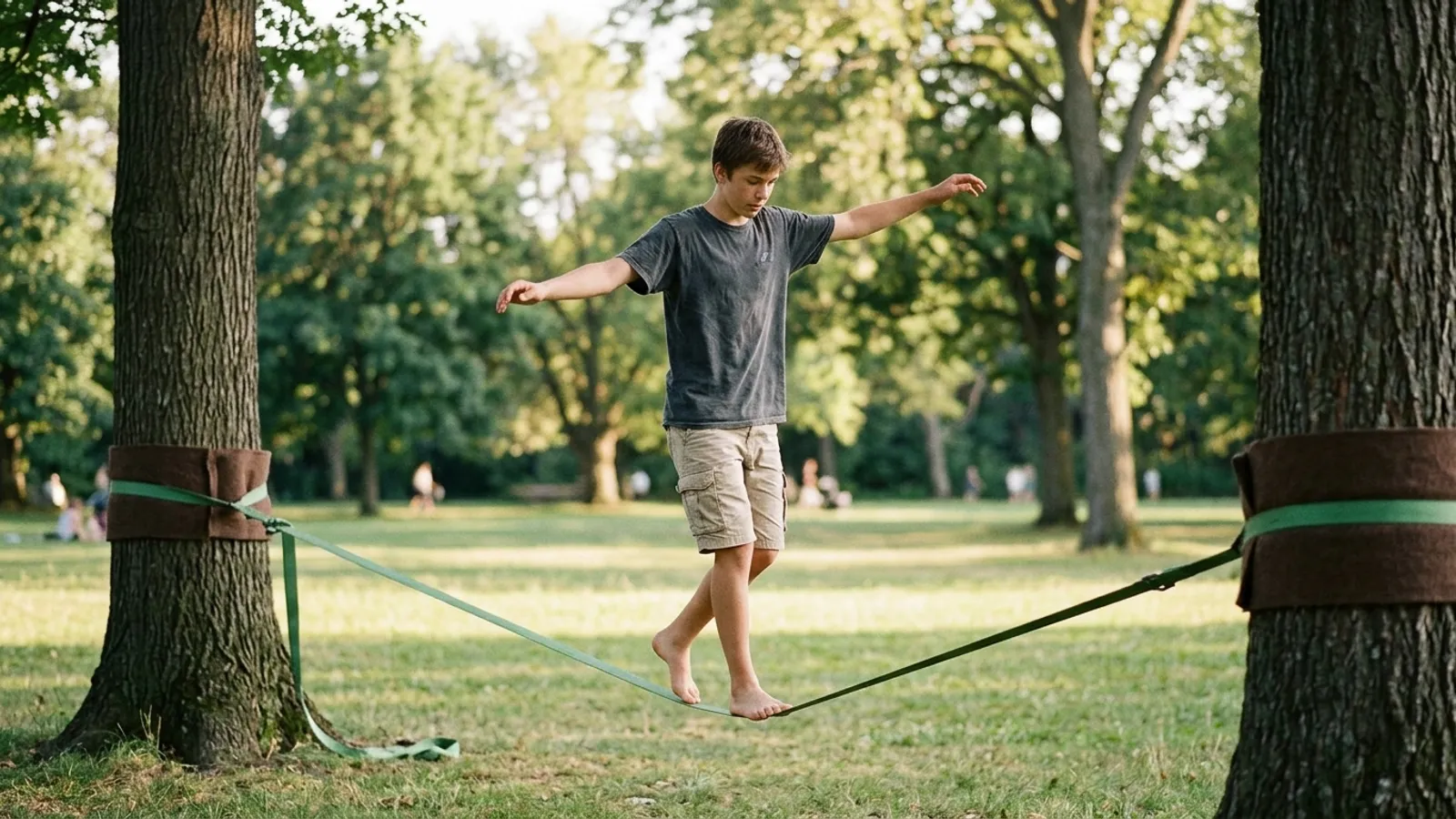
Thinking about canceling your membership and training at home instead? The idea of a slackline instead of the gym sounds tempting at first: buy it once, no monthly fee, no crowded equipment room at 6 p.m. But does the line live up to its promise? In this comparison we take an honest look: what the slackline does really well, where the gym clearly wins, and how you use both for yourself.
Slackline instead of the gym: an honest comparison
First, so no false expectations arise: a slackline is not a complete replacement for every training goal. It’s a very good tool for certain things and weak at others. That’s exactly what makes the comparison interesting.
The gym sells you variety: dumbbells, machines, cardio equipment, classes, sometimes a sauna. The slackline sells you depth in a narrow area, namely balance, core and body awareness. Both have their place.
The biggest difference lies in the model. The gym is a membership that costs every month, whether you show up or not. The line is a one-time purchase that’s essentially free to use afterward.
How often did you actually train in the last quarter? If the honest answer is “rarely, because the trip is annoying,” then a flexible solution for home may be the better lever than a membership that gets debited unused.
What this comparison is about
We evaluate three things: cost, flexibility and training effect. With the effect, we clearly separate what the line demonstrably trains well from what you need classic equipment training for.
The goal isn’t to badmouth the gym. The goal is for you to make a decision that fits your goals, your wallet and your everyday life.
What the line does well
Let’s start with the strengths, because they’re real. A slackline challenges your body in a way that machines simply can’t replicate, because it creates constant instability.
Balance and proprioception
As soon as you stand on the line, your whole body works on stabilization. Small muscles in your feet, ankles and hips fire nonstop to balance you out. This constant counter-steering trains the depth perception of your joints better than almost any fixed exercise.
This is exactly what’s often missing in typical gym training, because machines guide the movement and don’t force you to compensate yourself.
You feel it in everyday life: standing more securely on a slippery floor, wobbling less when climbing stairs, finding your balance faster in sports. The line transfers these stabilizing abilities directly to real life.
Trunk and core
The line is a core trainer without you doing a single classic sit-up rep. Your core holds your upper body upright over the swaying band and has to catch every micro-movement. This trains the deep supporting muscles functionally, exactly the way you need them in everyday life.
You’ll find a detailed exercise progression from standing to squats on the band in the Slackline fitness guide.
Coordination and concentration
Slacklining is also a head game. You have to coordinate gaze, breathing and movement, otherwise you get wobbly. This connection of focus and movement is a side effect many underestimate, and it clears your head surprisingly well after a session.
Low barrier to entry
You need no prior experience and no chiseled physique. Beginners start ankle-high and build up step by step. Which set fits for the start is covered in the article which slackline suits beginners.
Where the gym has the edge
Now for the fair counterpart. There are goals where a line alone won’t get you far, and you should know that before you cancel your membership.
Heavy strength and muscle building
If you want to build muscle mass specifically or develop real maximal strength, you need progressive load. That means: weights that you increase step by step, for example on a barbell, dumbbells or machines. A slackline doesn’t give you additional weight that you can systematically increase.
It improves your stability and control, but it doesn’t replace targeted strength training with load. That’s not a weakness, it’s simply a different tool.
You can indeed add squats, lunges or push-ups on the line and get stronger with them. But the load remains your own body weight, and that has a natural ceiling.
Isolated muscle groups and rehab machines
In the gym you can target individual muscles specifically, for example with the leg press, lat pulldown or chest press. That’s useful after injuries, for muscular imbalances, or when you want to work very focused on one area. The line doesn’t offer this isolation.
Cardio and classes
For endurance-oriented training, meaning treadmill, rowing machine or spinning, the slackline isn’t designed. The social element of classes, the fixed structure and a trainer who corrects you are also missing at home. Some people need exactly this external framework to stay on track.
If group dynamics motivate you and you quickly lose discipline without a fixed appointment, that’s an honest argument for the gym. The best form of training is, in the end, the one you actually do regularly.
Bad weather and space
A line between two trees depends on the weather and needs suitable anchor points. Not everyone has a garden or two stable trees at the right distance. Here the classic outdoor line loses against the reliability of an indoor gym that’s always open and dry.
This space problem can be solved, though – more on that in a moment.
How to build your home setup
If the strengths convince you, you can create a flexible home setup with manageable effort. The nice thing: the purchase is one-time, and afterward there are no running costs, unlike the monthly membership.
Variant 1: classic between trees
If you have two stable trees at a suitable distance, a simple beginner set of band, ratchet and tree protectors is enough. That’s the cheapest solution and quick to set up.
Look for clean workmanship and a robust ratchet. Anyone who wants to play it safe orients toward equipment that aligns with the DIN 79400 standard. You’ll get a solid complete package as a beginner set for a quick start – so you have everything you need in one purchase.
Variant 2: with a frame, completely without trees
No garden, no trees, an apartment instead of a plot? Then a slackline frame is the solution that completely sidesteps the seasonal problem. You set it up in the living room, the basement, the yard or on the terrace and train independently of weather and location.
This is exactly where the line really scores against the gym: your training equipment stands right next to you and is ready in minutes. A flexible frame for indoors and without a tree like this turns the fair-weather hobby into year-round training.
What else you need
It’s not much. A few square meters of free, soft surface, comfortable clothing and a little patience in the first sessions. A mat under the line cushions wobbles and gives extra safety at the beginning.
Plan your training realistically. Three short sessions per week of ten to fifteen minutes get you further at the beginning than one long session that you then let slide for a week.
A practical advantage over the gym: the barrier is tiny. No packing a bag, no commute, no waiting at the equipment. You step on the line briefly whenever you feel like it, and exactly this spontaneity is what keeps many people going at all.
The honest verdict
For balance, core stability, coordination and flexible training at home, the slackline is a strong, often significantly cheaper alternative to the annual membership. For heavy muscle building and targeted isolation, the gym remains superior.
The clever solution is often not an either-or question. Anyone who wants maximal strength combines both. Anyone who mainly wants to become more stable, more mobile and more body-aware gets surprisingly far with the line. Browse through fitting sets at your leisure in the Primeful shop and find what suits your space and your goal.
Frequently asked questions
Can I really build strength with a slackline?
You build functional supporting and stabilizing strength, especially in your core, legs and the small joint muscles. For targeted muscle building with heavy, increasable load, you additionally need classic strength training. The line complements that excellently, but it doesn’t replace it for this specific goal.
Is the slackline worth it financially compared to a membership?
As a rule, yes, if you train regularly. The line is a one-time purchase and causes no running costs afterward, while a gym debits every month. Exact amounts depend on the set and your membership, but the cost advantage over time is usually clear.
Do I need a garden or trees?
No. With a slackline frame you train indoors as well as outdoors, completely without trees and independent of the weather. That removes the biggest limitation of the classic outdoor line and you can practice all year round.
Is slacklining also suitable for untrained beginners?
Yes. You start ankle-high, hold on at first, and build up in small steps. More important than prior experience are patience and consistency. Even short, frequent sessions show noticeable progress in balance and steadiness after just a few weeks.