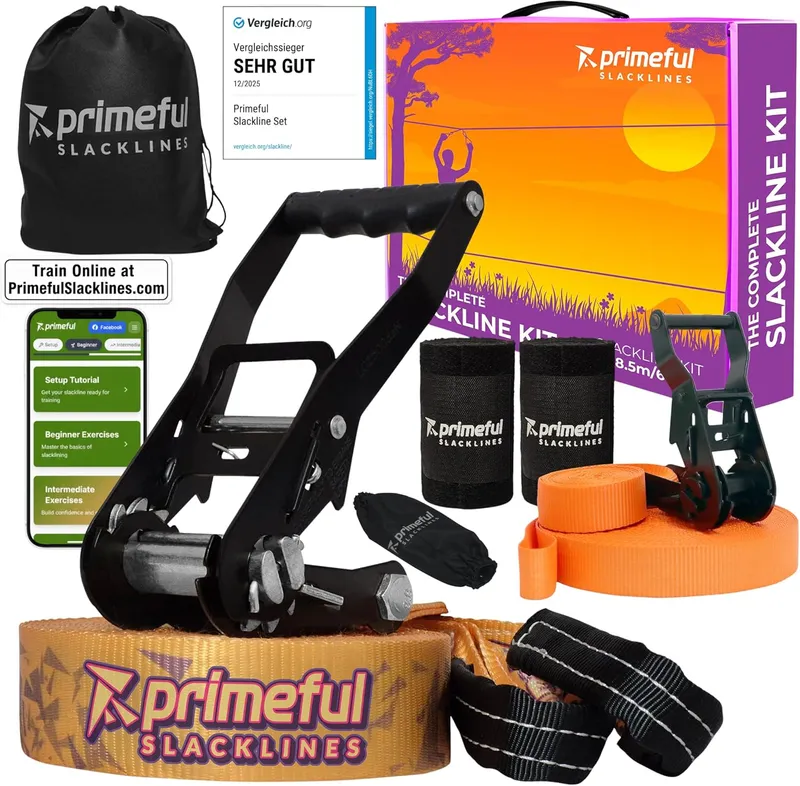
Primeful slackline set with training line
A complete set for indoors and out — beginner-friendly, including a training line for safe practice.
Slackline fitness may be the most underrated full-body workout out there: a narrow band, your own body weight – and suddenly your feet, core and head are all working together. Unlike the machines at the gym, the line gives you constant feedback. Every small wobble has to be corrected, and it’s exactly this counter-steering that turns slackline fitness into real training for core, balance and stability. The best part: you need neither prior experience nor perfect weather. With the right setup it works all year round – indoors and out.
Why slackline fitness is a real workout
On the line your body is never still. The moment you bring your weight onto the band a fine interplay begins: the deep trunk muscles (your “deep core”) stabilise the spine, while your hips, knees and ankles adjust non-stop. These constant micro-corrections are the real training stimulus.
On top of that comes proprioception – your sense of where your joints are in space. It’s particularly challenged on an unstable surface. So you’re not only training muscles, but also the communication between nerves and muscles. That’s what makes slackline core training so efficient: in just a few minutes, everything that keeps your body upright and stable is working.
Another plus: slackline fitness is highly scalable. At the start it’s enough just to stand securely – that alone is a full stimulus for your core. Later you raise the difficulty with no added weight at all, by closing your eyes, balancing on one leg or adding small movements. That way the load grows with your ability, and on the very same band you keep finding a fresh challenge – from day one to months later.
The training on the line is also gentle on the joints: there are no hard impacts like when jogging, just soft, controlled movements. That makes it a good choice if you want to become more mobile and steady again after long hours of sitting – regardless of your current fitness level.
Train all year round — indoors too
The biggest myth about the slackline: “I need two trees and summer for that.” Not true. With a sturdy frame, slackline indoor training becomes a home workout – in the living room, the basement or the garage. No garden, no trees, no season: you tension the line in the frame, and your balance training at home can begin, even when there’s snow outside.
A frame has another advantage: the height and tension are always the same, so you train under reproducible conditions. When buying, look for tested quality: the German standard DIN 79400 describes the requirements for slacklines and gives you a reliable point of reference. Handy: a frame needs surprisingly little space, is set up in a few minutes and quickly stowed away again after training.
Indoors you can also plan your training better: a fixed time, the same conditions every session, no glancing at the weather app. In the dark months especially, that reliability helps you actually stick with it. Set the line up where you already pass by often – left visible, it gets used far more than rolled up in a cupboard.
View the slackline with frame Set it up, get going, put it away – no tree needed.We show you step by step how to set up and safely tension the line – indoors and out – in our setup and beginner’s guide.
Exercises from beginner to advanced
This progression takes you from your first wobbly stand to genuine strength exercises on the line. Work through it in order – each level builds on the one before.
Standing & first steps
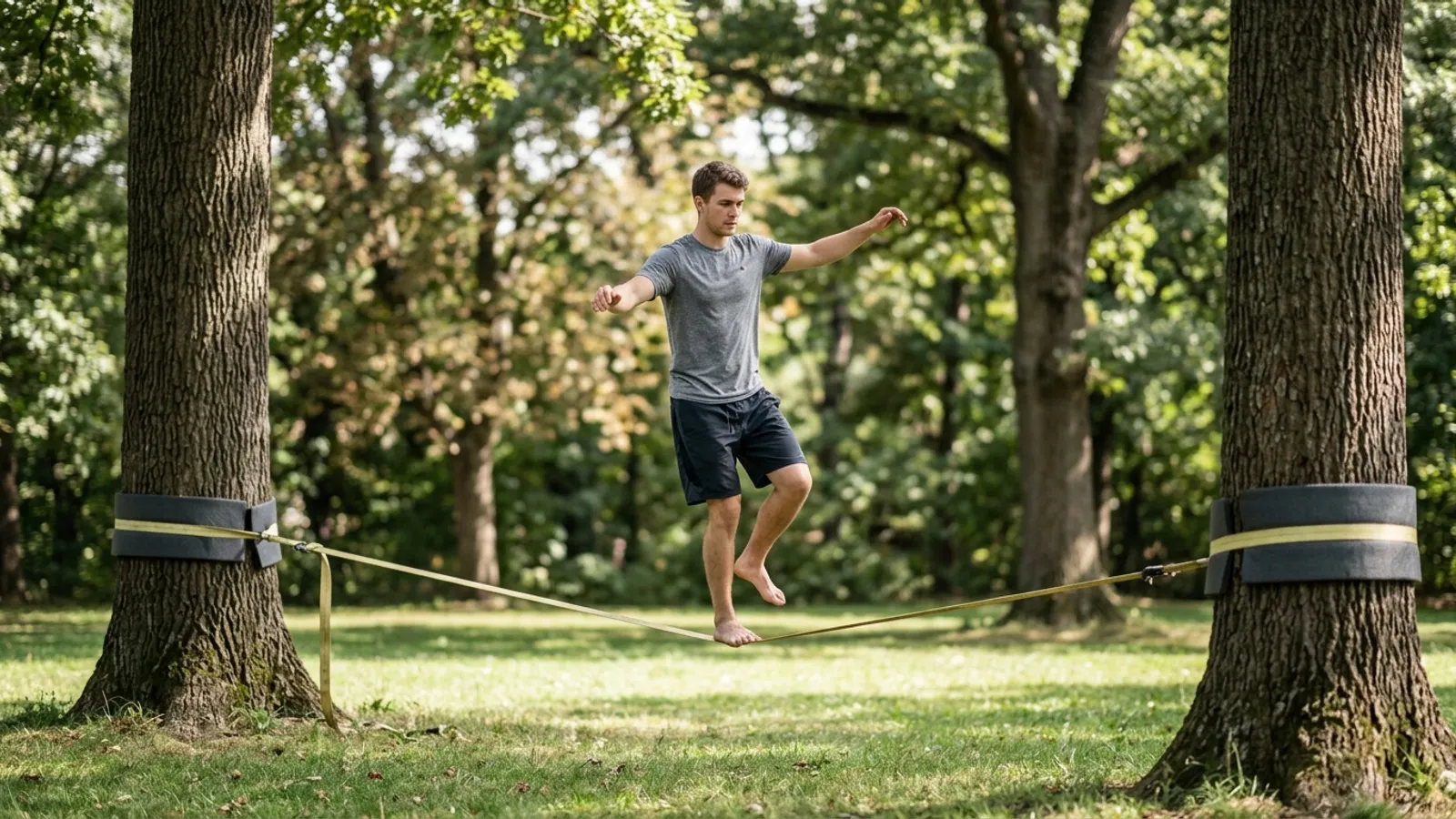
Stand in the middle of the line, one foot lengthwise on the band. Look ahead at a fixed point – not at your feet. Arms up above shoulder height, they’re your balancing oar. Hold on one leg first, then add the second foot.
Form-Hinweis: Knees soft, don't lock them; the tension comes from your core.
Squat & lunge
Once you stand securely, you go deeper. A slow squat forces your core to hold balance through the whole range of motion. Advanced athletes switch to a single-leg stand.
Form-Hinweis: Weight in the middle of the foot, chest upright, lower and rise under control.
Push-up & dips
Now you use the line as an unstable support for your upper body. Hands shoulder-width on the band (or your forearms for the easier variant) and keep your body in one line. A few clean reps are enough.
Form-Hinweis: Belly firm, don't let your hips sag.
Seated balance
Sit crosswise on the line and lift your feet off the ground. It looks harmless, but it’s intense core training: you balance purely through trunk tension. If you like, extend your arms.
Form-Hinweis: Spine long, shoulders down, gaze straight ahead.
You’ll find more sport-specific drills – for instance as a complement to climbing, skiing or surfing – in our post on slackline cross-training.
Your 4-week start
You don’t need a daily programme. Two to three short sessions a week are enough to become noticeably steadier. Here’s what your start could look like:
| Woche | Fokus | 2–3× pro Woche |
|---|---|---|
| 1 | Settling onto the line | Stand on one leg, build up short holds |
| 2 | First steps | Walk forwards and back, calm breathing |
| 3 | Adding strength | Squats, first support variants |
| 4 | Combining | Steps + squat + seated balance |
Important: quality over duration. Five clean minutes with full concentration beat twenty tense ones. If a day doesn’t work out, that’s no setback – balance is a skill that builds over weeks, not overnight.
What the research shows
Staying honest also means this: a slackline is no miracle cure and won’t transform a body overnight. What can be well argued, though, is its effect on balance and trunk stability. Balance training on an unstable surface challenges postural control and the deep supporting muscles – that’s the mechanism slackline training rests on, and it’s well established in sports science. Consistency is key: the body adapts to recurring, mildly challenging stimuli.
Realistically: after a few weeks you’ll stand more securely, move more consciously and feel a more alert core. In everyday life that’s often worth more: standing safely on one leg, preventing falls, a more upright posture. You won’t find promises about weight loss or a “six-pack in X days” here on purpose.
Frequently asked questions
Do I need prior experience for slackline fitness?
No. The first level is simply “stand securely”, and almost everyone learns that in their first session. Hold on to a wall, a pole or a helping hand at the start – that’s not cheating, it’s sensible progression.
How often should I train?
Two to three short sessions a week are enough to begin with. Balance improves through consistency, not marathon sessions. Just 5–10 minutes of focused practice will move you forward.
Does it really work entirely without a garden?
Yes. With a frame the slackline becomes an indoor training device. That way you stay on it in winter too and aren’t dependent on trees or weather.
Train barefoot or with shoes?
Both work. Barefoot you feel the band better and train your foot muscles along the way; with flat, grippy shoes you often stand a little more steadily at first. Try out what feels safer for you.
Ready to dive straight in? Pick the entry point that fits your home.