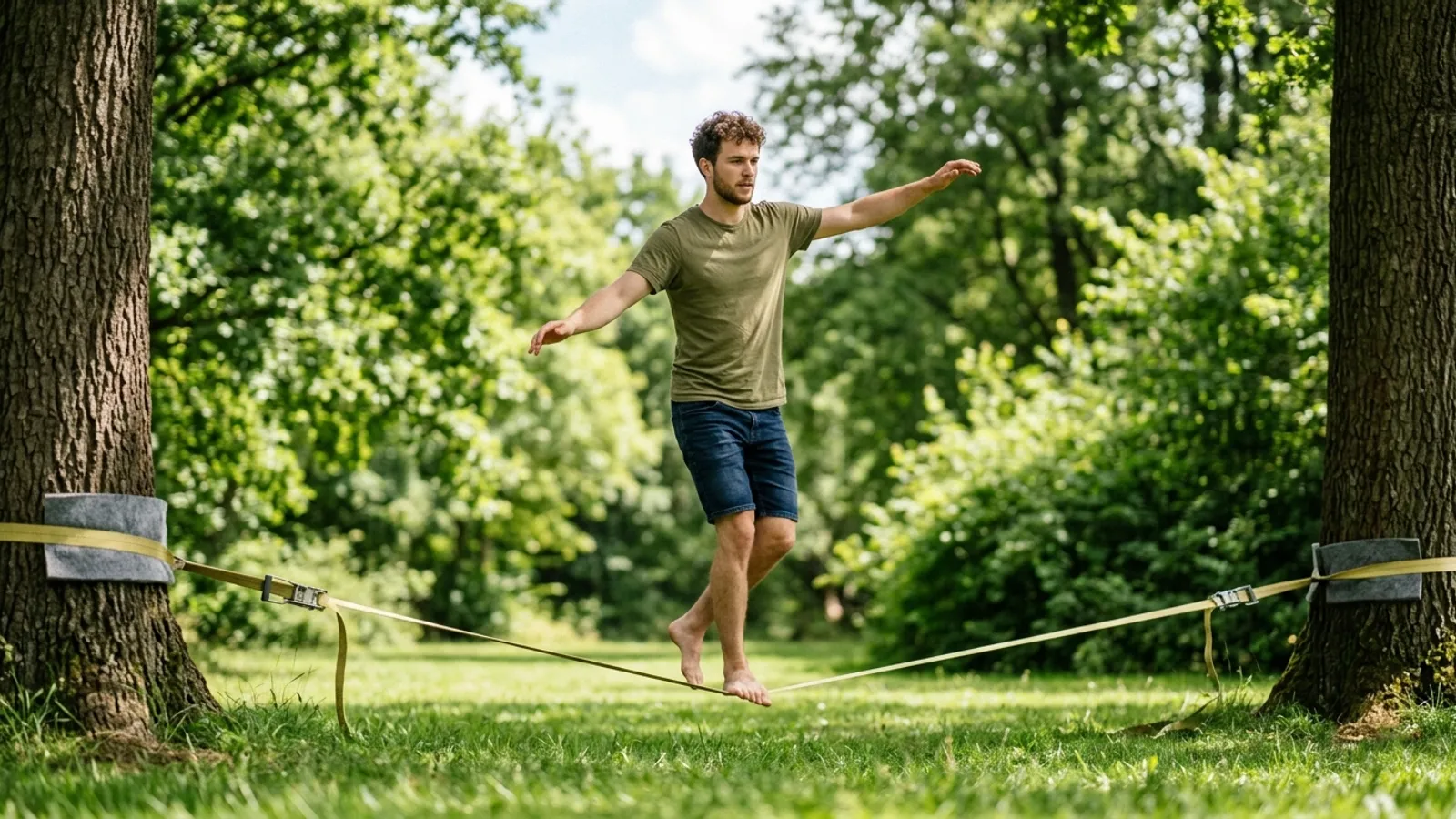
A slackline in the office sounds like an odd idea at first – until you notice how well a short balance break works against eight hours in a chair. That’s exactly the point here: a slackline in the office is your tool for the active break that gets your back, circulation and head going again. No changing clothes, no gym, just two or three minutes between two meetings.
Slackline in the office: why it makes sense
You know the feeling in the afternoon: your neck is stiff, your thoughts turn sluggish, and the coffee doesn’t really help anymore. Movement at work often works better than caffeine here – it brings fresh blood to your head and releases the tension that has been building up over hours.
The slackline turns this movement into something that truly challenges your body. On the narrow band you constantly have to balance yourself out, and that activates exactly those deep muscles around the spine that fall asleep while sitting. It’s not a sport for breaking a sweat, but focused micro-movement.
On top of that comes the mental effect. Anyone standing on the line can think of nothing but the next step – that’s a little timeout for your head. We describe how closely balance and a calm mind are connected in more detail in the article stress relief on the line.
Perhaps the best point: an active break on the line takes less time than a trip to the vending machine. You don’t need sportswear, you don’t break a sweat, and you don’t need an appointment. You step on, take a few steps, and go back to your desk more alert.
And unlike the well-intentioned evening workout, this break is guaranteed to happen – because it sits right in the middle of your workday and needs only seconds of preparation. It’s exactly this low barrier that turns a nice idea into a real habit.
Who benefits most from this
Heavy sitters benefit most – meaning everyone who spends most of the day in front of a screen. The idea also fits break rooms, small office fitness corners or the home office. A team can share the line, and the break becomes a small shared ritual.
In the home office in particular, the unconscious movement that an office otherwise brings with it falls away: no walk to the coffee kitchen, no stairwell, no spontaneous standing meeting. A fixed station for the active break replaces exactly these lost micro-movements – and often with more effect than the occasional trip to the fridge.
Against the effects of sitting
Sitting for long periods isn’t inherently harmful, but our body is built for change, not for holding one posture for hours. It’s exactly this monotony that causes the typical complaints many know from office life.
Your back shortens at the front and weakens at the back. The hip flexors contract while the trunk muscles stay passive. On the slackline you reverse this: your core works nonstop, and you automatically straighten up to keep your balance.
Your circulation slows down noticeably while sitting. The blood pools in your legs, circulation decreases, and that’s exactly what makes you tired. Just a few steps on the line get your leg muscles pumping again and kickstart your circulation.
Concentration is something many people boost more easily through movement than through discipline. A short, physically demanding interruption can clear your head and make the next block of work easier to start. That’s experience, not a miracle cure – but one you can feel for yourself after just a few tries.
Your posture benefits too
Anyone who balances briefly on a regular basis trains upright standing on the side. You notice faster when you start slumping again, and you correct it. You take this body awareness back to your desk – and often sit more consciously on your own.
The reality remains important: the line doesn’t replace ergonomic furniture or a doctor’s visit for genuine complaints. It’s a simple building block that keeps the day in motion. A good active break doesn’t need more than that.
Mini-exercises for the break
You don’t have to walk across the line to get something out of it. Even small standing exercises work – and those fit perfectly into two or three minutes in between. At the beginning, feel free to hold on to a wall or a colleague; that’s not cheating, it’s a good entry point.
One-legged stand with support
Stand with one foot on the line; the other stays beside it for safety or slightly in the air. Eyes forward on a fixed point, not on your feet. Hold for ten to twenty seconds, then switch sides. This exercise wakes up your foot muscles and deep core tension right away.
Two-legged stand and small weight shift
Both feet lengthwise on the line, a hip-width feel in the pelvis, knees minimally bent. Slowly shift your weight from one foot to the other without losing your stance. This trains the micro-corrections that are completely missing while sitting.
Half squat on the band
Once your stance is secure, lower yourself a few centimeters and come back up in a controlled way. Not deep – balance matters more here than depth. Even a hinted squat challenges your thighs, glutes and core at the same time.
Conscious breathing steps
Take a step on the line and breathe out calmly as you do. On the next step, do it again. This slow rhythm connects movement and breath and turns the break into real recovery for your head.
If you only have a little time, a single one of these exercises is enough. Pick the one that gives you the most and do it cleanly – that makes more sense than rushing all four. You’ll find a detailed exercise progression from beginner to advanced in our Slackline fitness guide.
Three short rules for the office break: shoes off or non-slip socks, calm ground without trip edges, and rather short and focused than long and sloppy. Quality beats duration.
Setup without a tree indoors
In the office, the two trees you’d string a line between outdoors are missing – and that’s exactly what holds many people back. The solution is a free-standing frame with ground anchoring. It brings its own mounting, so you don’t need a wall, a tree, or any intervention in the building structure.
The setup is surprisingly uncomplicated. The frame is set up, the line is tensioned, and your active-break station is ready. Everything is stowed away just as quickly when the room is needed for something else. That makes it ideal for shared break rooms.
The space requirement is also modest. A low-tensioned line mainly needs free length, hardly any width, and the height stays just above the floor. In many offices, a quiet corner or a rarely used hallway section is completely enough.
If you want to go the indoor route, the right system is the key: here you can look at the slackline with a frame for indoors without a tree and check whether it fits your rooms. A flat-tensioned setup is especially pleasant for beginners, because the floor is close and the intimidation is small.
What to look for in the equipment
Stability comes before everything else. Look for a cleanly finished frame, a reliable ratchet and non-slip feet. As a rough guide for tested slackline quality, there is the DIN 79400 standard – it’s not a must for the office, but it helps with orientation.
A slightly wider band stands more steadily and forgives beginner mistakes more readily. If you’d rather start classically between fixed points, you’ll find an affordable entry in the beginner set with band and ratchet – but in the office the frame usually remains the more practical choice.
Before you decide, it’s worth a look at the options: you can browse the Primeful shop at your leisure and compare sets, frames and accessories. That way you’ll find the setup that fits your room and your budget – and your next break becomes a little movement session.
Frequently asked questions
How much space do I need for a slackline in the office?
Mainly free length along the line, hardly any width. A quiet corner or a rarely used hallway section is often enough. A frame with low tension gets by with surprisingly little space and can be stowed away again after the break.
Do I really not need any drilling or a tree for indoors?
No. A free-standing frame with ground anchoring brings its own mounting and stands without any intervention in the wall or ceiling. That’s the whole advantage over the classic setup between two trees and ideal for rented spaces and break zones.
How long should an active break on the line last?
Two to three minutes are enough for the effect. Rather short and focused than long and sloppy – just a few standing exercises or steps get your circulation and head going again. You can easily fit this in several times a day.
Is this also suitable for absolute beginners?
Yes. Hold on to a wall or the frame at first and start with the two-legged stand on a low-tensioned band. With every break you’ll become more secure. If you want to build up step by step, you’ll find the full progression in our Slackline fitness guide.