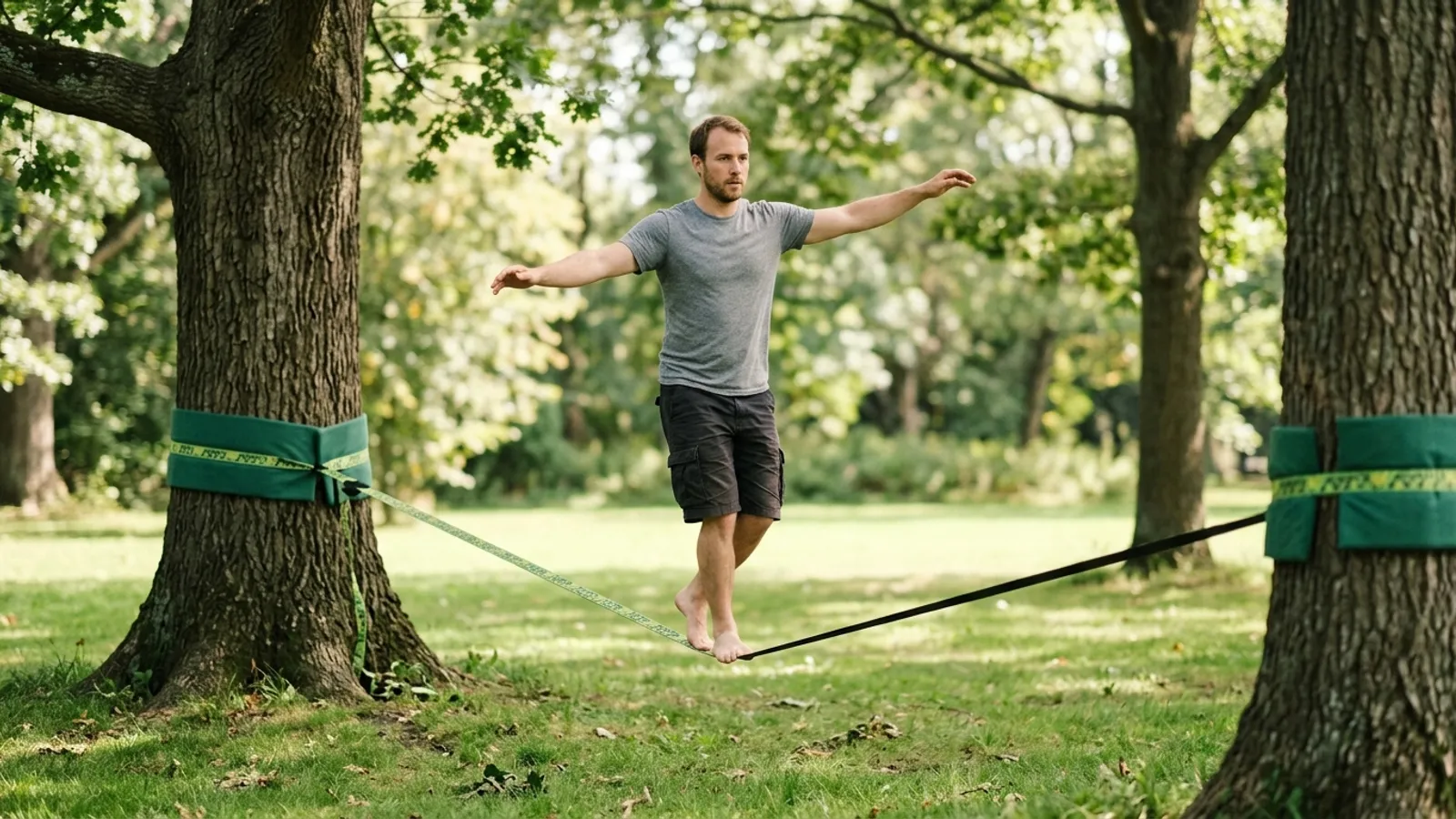
When your head is full, more thinking usually doesn’t help – something that demands your full attention does. This is exactly where slackline stress relief comes in: the moment you stand on the narrow band, your brain no longer has capacity for brooding over the day. You’re simply there – and that’s the point.
This article isn’t about abs or calories, but about your head. About how balancing creates focus, brings you down and leaves you surprisingly clear after a few minutes. No big promises, no cure-all – just an honest assessment and a short routine you can try right away.
Slackline stress relief: why it works
Stress often lives in your head: open to-dos, thought loops, the constant planning ahead. What helps isn’t relaxation on demand, but a task that demands your full presence. Slackline stress relief works because the band does exactly that – it forces you into the here and now.
On a line, you can’t think about your tax return and hold your balance at the same time. Your body constantly reports where you’re tipping, and you counter-steer. These micro-corrections happen so quickly and so densely that there’s no room left for anything else. That’s not esoterics, but simply a matter of attention: it’s limited, and balancing claims it almost entirely.
There’s also a physical side effect. When you balance with concentration, you automatically breathe more calmly and evenly – tensely holding your breath makes every step wobblier, you notice that immediately. Calm breathing and an alert but not overwound mind go hand in hand. Many describe the feeling afterward as an “emptied head”: no big aha, more a clean reset.
The honest assessment matters: a slackline is not a substitute for therapy and not a treatment. In the case of serious, lasting strain, that belongs in expert hands. What the band does well is give you small, regular breaks from the mental carousel – and in everyday life, that’s already worth a lot.
The threshold to get started is also striking: you need to bring nothing but the willingness to be wobbly for a few minutes. There’s no choreography to learn, no equipment to set up, no right or wrong thought. This very simplicity makes it easy to start again and again – even on days when you lack the energy for a long workout.
Flow on the line
There’s that state in which an activity fully absorbs you: you forget time, the inner commentator goes quiet, and the doing feels almost effortless. People experience this flow while climbing, making music, drawing – and very reliably on the slackline too.
The reason lies in the balance between challenge and ability. If a task is too easy, you get bored. If it’s too hard, it frustrates you. The line hits the point in between almost on its own, because you can constantly adjust the level: tension it lower, hold on briefly, stand on one leg before you set off. You’re always challenged just enough to stay with it without being overwhelmed.
How you notice the flow
- Time passes faster than you thought – “just a quick try” has turned into twenty minutes.
- Your inner monologue grows calmer; you no longer comment on every wobble.
- After a fall you want to get right back up, without getting annoyed.
- After the session your head feels clearer, even though you’ve exerted yourself physically.
The trick is to leave the ego outside. On the line it’s not about perfection, but about feeling. Every fall is information, not failure. This very attitude – curious instead of grim – makes the difference between frustrating practice and real flow. And it can be practiced: the more often you step onto the band, the faster you find your way back in.
It helps to have a setup where you don’t have to fight with the technical side. A cleanly tensioned, sufficiently wide band with a good ratchet system makes the start calmer – you waste no attention on wobbly setups. If you want to start without fuss, the beginner set with band and ratchet has everything to be ready in a few minutes. That way your energy goes into balancing instead of fiddling.
A short mindfulness routine
Slackline mindfulness doesn’t mean you meditate or think something special. It only means: you step on consciously instead of just flailing around. This mini routine takes about five to ten minutes and works well after work or during a break.
Step 1 – Arrive and breathe
Stand next to the band, feet hip-width apart, and take three calm breaths. Breathe in through your nose, exhale a little longer through your mouth. This signals to your body that it’s now break time from “function” mode. Briefly feel the ground under your feet before you step on for the first time.
Step 2 – Anchor your gaze
Don’t look at your feet; find a fixed point at eye level – a branch, a post, a mark on the wall. This calm gaze is your anchor. As long as you hold the point, your stance also becomes calmer, and your thoughts have less room to wander. When you drift off, you simply come back to the focal point.
Step 3 – Focus on one thing
For each round, choose only one focus: this round the breath, the next the gaze, then the sole of your foot. This focus training is the real core. You practice consciously directing your attention instead of letting it be carried off by the stream of thoughts – a skill that’s useful far beyond the band.
Step 4 – Falling without drama
You will fall, again and again. Treat every step down as a matter of course, not as a mistake. A quick shake, breathe, back up. If you don’t judge the fall, your head stays calm and you find your way back into your mental balance faster. That’s exactly the exercise: getting up without scolding yourself.
This works just as well indoors, by the way. On cold or rainy days you need no tree and no garden – a slackline with frame for indoors makes the routine possible year-round, in the living room or hobby room. That way the break from your head stays available even in winter, when you often need it most.
Building it into everyday life
The biggest effect doesn’t come from that one long session, but from regularity. Short, frequent sessions beat rare marathon sessions – for the sense of balance as for your head. Even ten minutes on three or four days a week is enough to make the reset a habit.
In practice that means: leave the band set up or ready to hand, so the hurdle stays small. If the setup costs two minutes, you’ll do it sooner than if you have to fetch everything from the basement each time. Link the line to a fixed moment – after work, before dinner, as the transition between job and free time.
How you stay with it
- Fixed triggers: Always on the band at the same occasion, for example right after getting home.
- Start small: Better five focused minutes than forcing yourself into big resolutions.
- No goal pressure: It’s about winding down, not about top performances or tricks.
- Practice together: Two on the line is more fun and you’re more likely to stick with it.
As you get more confident at standing and walking, it’s worth looking at the physical side. How to specifically train your trunk and balance on the band is shown step by step in the Slackline fitness guide. And for the short break in between, the active break in the office offers ideas on how to sneak movement into the workday.
When buying, look for solid build quality and traceable quality details – the German DIN 79400 standard for slacklines is a good reference here. If you want to get an overview of sets, frames and accessories, you can browse the Primeful shop at your leisure and find the right setup for your space.
In the end, a simple idea remains: you don’t need a big program to clear your head. A narrow band, a calm gaze and a few conscious breaths are enough to step out of the mental carousel – and that’s exactly what makes the line an unusually good tool for in-between moments.
Frequently asked questions
How quickly does the effect set in?
Often as early as the first session: as soon as you concentrate on balancing, the mental carousel grows quieter. The “clear head” afterward lasts for most people a few minutes to hours. With regularity you find your way into the calm state faster.
Do I need experience to feel the flow?
No. Especially at the start, just standing challenges you so much that your attention wanders onto the band almost on its own. The only important thing is to choose a fitting level – tension low, holding on allowed – so you’re neither bored nor overwhelmed.
Is this a method against stress or anxiety?
It’s an everyday-suitable break from brooding, not a substitute for therapy and not a treatment. With lasting or distressing tension, please talk to a professional. The line can do good alongside it, but replaces no professional help.
Does this also work without a garden or tree?
Yes. With an indoor frame you need neither trees nor much space and can practice year-round – even in rain or in winter. That way the short routine stays available all year long.