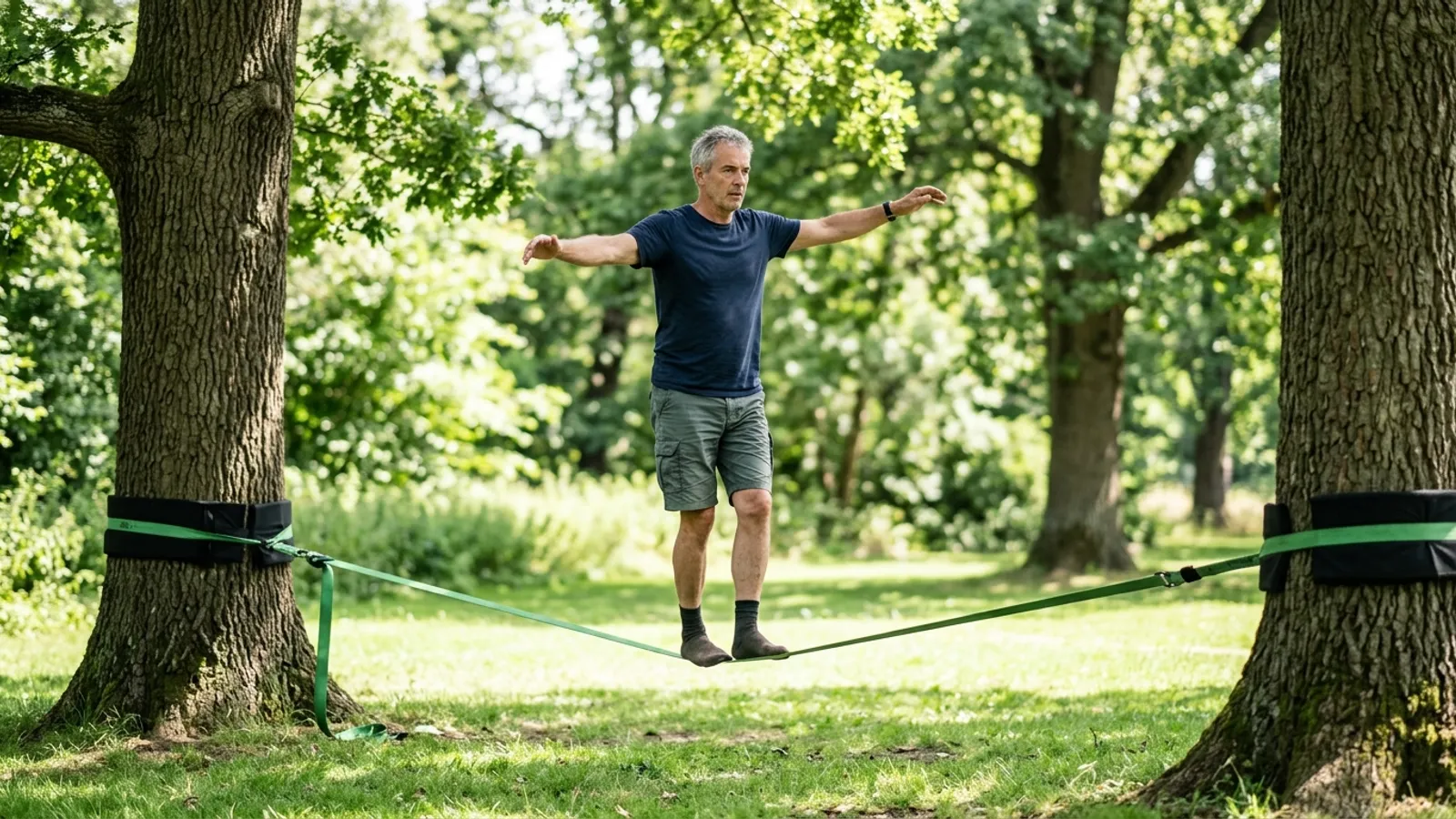
When you hear the word slackline, many first picture young people balancing on a high band over a park. But a slackline for seniors looks quite different: a flat band, just above the ground, plus a handhold and a few calm minutes of training. It’s not about stunts, but about staying securely on your feet in everyday life. And that can be practiced at any age – gently, at your own pace and without any pressure.
In this article you’ll read whether it’s worth it for you, how to set everything up safely and which gentle exercises are suitable for getting started.
Slackline for seniors: is it worth it?
Balance isn’t a fixed trait that simply disappears at some point. It’s an ability your body practices continuously – or unlearns when you challenge it too rarely. Over the years the small, automatic corrections get slower: the foot reacts a touch later, the trunk no longer counter-steers quite as nimbly. A slackline for seniors addresses exactly these fine reactions, because the band gives slightly under you and invites you into constant, tiny balancing movements.
The nice thing about it: you don’t train dully, but attentively. Your body has to feel where your center of gravity is and keep bringing it back. This perception – experts call it proprioception – is the foundation for standing and walking securely.
There’s also a very practical advantage: on the line you’re fully attentive to the task. You concentrate on your stance, on a point in front of you, on your breath. This short, focused exercise does good not only for the legs but also brings the head to rest – a small moment for yourself, entirely without performance pressure.
A realistic view belongs here too. A slackline is no miracle cure and replaces no medical treatment. It’s a tool with which you can maintain steadiness and self-confidence. Many people report feeling more secure after regular practice – on the stairs, dressing while standing or on uneven ground. This very feeling is the goal, not the perfect pose.
What you can realistically expect
- More body awareness and a better sense of your center of gravity
- Firmer, more active foot and leg muscles through the constant balancing
- A bit more security and composure in everyday situations
- A form of training that’s fun and fits well into short sessions
What you shouldn’t expect are quick leaps or promises like “never stumble again.” Progress in older age means small, steady steps. If you bring patience, that’s more than enough.
Build it safely: low and stable
Safety decides whether the training is a joy or a worry. That’s why the setup is more important than any exercise. The basic rule: as low and as stable as possible.
A classic slackline between two trees can be tensioned low, but often the right distance or a second tree is missing. For many, a model with a frame is more convenient. A frame at a comfortable height stands freely in the garden or even indoors and makes you independent of weather and trees. You step on from the side without having to bend down low, and the band sits at a height that gives you a good feeling. If you want to start without a tree, the range includes a slackline with a height-adjustable frame for a comfortable start, tailored exactly to this need.
Your safety checklist
- Tension it low: The band belongs just above the ground, so you can simply step off at any time.
- Soft ground: Lawn, a thick mat or a soft hall floor cushion a misstep. Avoid hard tiles or stone slabs.
- Clear space: Around the line nothing should stand that you could bump into. Keep the surroundings tidy.
- Sturdy shoes or barefoot: Both work. Barefoot you feel more, sturdy shoes give support – try out what suits you better.
- A handhold within reach: A stable chair with a backrest, a railing, a wall or a helping hand. That way you’re never left to fend for yourself.
Don’t tension the band too loosely. A taut, low band swings less and is more predictable than a sagging one. For the first weeks, a near-ground setup with a reliable handhold is entirely enough. A well-made set is worth it here: when buying, look for notes on load capacity and the orientation to the DIN 79400 standard as a reference point for solid slackline gear.
Gentle exercises with a handhold
Now to the actual practice. Keep each session short – five to ten minutes is enough at the start. Better often and relaxed than rarely and exhausting. Keep breathing calmly, hold your gaze forward on a fixed point instead of on your feet, and stay with both hands or one hand on your handhold as long as it feels good.
Stand on one leg with a two-handed hold
Stand next to your chair or by the railing. Place one foot flat and centered on the band, hold on with both hands and slowly shift a bit of weight. You don’t have to step fully up – even the first contact trains your perception. Switch the foot after a short while.
Two-legged stand with hand contact
Step on from the side so that both feet stand lengthwise on the band. Hold on to the support and try to stand calmly. Feel how your feet constantly make small corrections. Even ten to twenty seconds of calm standing is a good start.
Shift your weight
Stand calmly on the band and gently shift your weight from one foot to the other, then slightly forward and back. These small pendulum movements train exactly the reactions that catch you in everyday life. Your hand stays on the handhold.
Letting go for a moment
When you feel secure, for a moment keep only one hand on the support – later briefly take both off and touch again right away as soon as it wobbles. Only increase this as far as it feels comfortable. There’s no reason to rush.
If you’d rather start fully near-ground and classic, you’ll also do well with a beginner set for safe practice at your own pace. Low setup, one hand on the railing – it takes no more than that to begin.
What to watch out for
So that the training stays a good habit, a few points matter more than any ambition. They cost you nothing but a little attention, yet make practicing noticeably safer and more pleasant.
Talk to your doctor first. This applies especially with dizziness, known balance disorders, osteoporosis, after operations or injuries, and with conditions that affect your steadiness. A brief medical assessment gives you clarity on whether and how you should start. That’s no sign of excess caution, but of good sense.
Never practice alone when you’re unsure. A second person nearby brings calm and can help if in doubt. Even just knowing someone is there makes practicing more relaxed.
Listen to your body. Light wobbling is normal and part of it. Pain, strong dizziness or a queasy feeling, on the other hand, are a clear stop signal. End the session, sit down, and continue next time. It’s not a competition.
Stay with it, but gently. Two to three short sessions per week bring more than one long, strenuous workout. Regularity beats intensity – especially with balance in older age.
Celebrate small progress. Today you stood calmly five seconds longer, tomorrow you briefly let go with one hand – those are real successes. Whoever notices them stays motivated. It helps to briefly note how long you stood or how secure it felt. That way you see in black and white over the weeks that something is moving – even on days when it feels tough.
If you’d like to put together the right gear, you can browse the Primeful shop at your leisure and compare what suits your space and your wishes. You can also go deeper into the topic in our article on fall prevention with the slackline and in the more comprehensive Slackline fitness guide, which shows exercises for all levels.
Frequently asked questions
Isn’t slacklining in older age too dangerous?
With a very low-tensioned line, soft ground and a firm handhold, the risk is low, because you can simply step off at any time. What matters are the careful setup and a calm pace. With dizziness, balance disorders or after injuries, you clarify the start with a doctor beforehand.
From what age does this still make sense?
There’s no fixed age limit. As long as you can stand and walk securely, balance can be practiced – that’s true at 60 just as at 80. More important than age are your state of health and a careful build-up.
How often and how long should I practice?
Two to three short sessions per week of five to ten minutes is a good framework. Regularity brings more than long, rare workouts. Listen to your body and rather take a break before you get tired.
Do I absolutely need a garden or trees?
No. With a frame you set the line up freely – in the garden, on the terrace or, with enough space, indoors too. That way you’re weather-independent and need no two suitably placed trees.