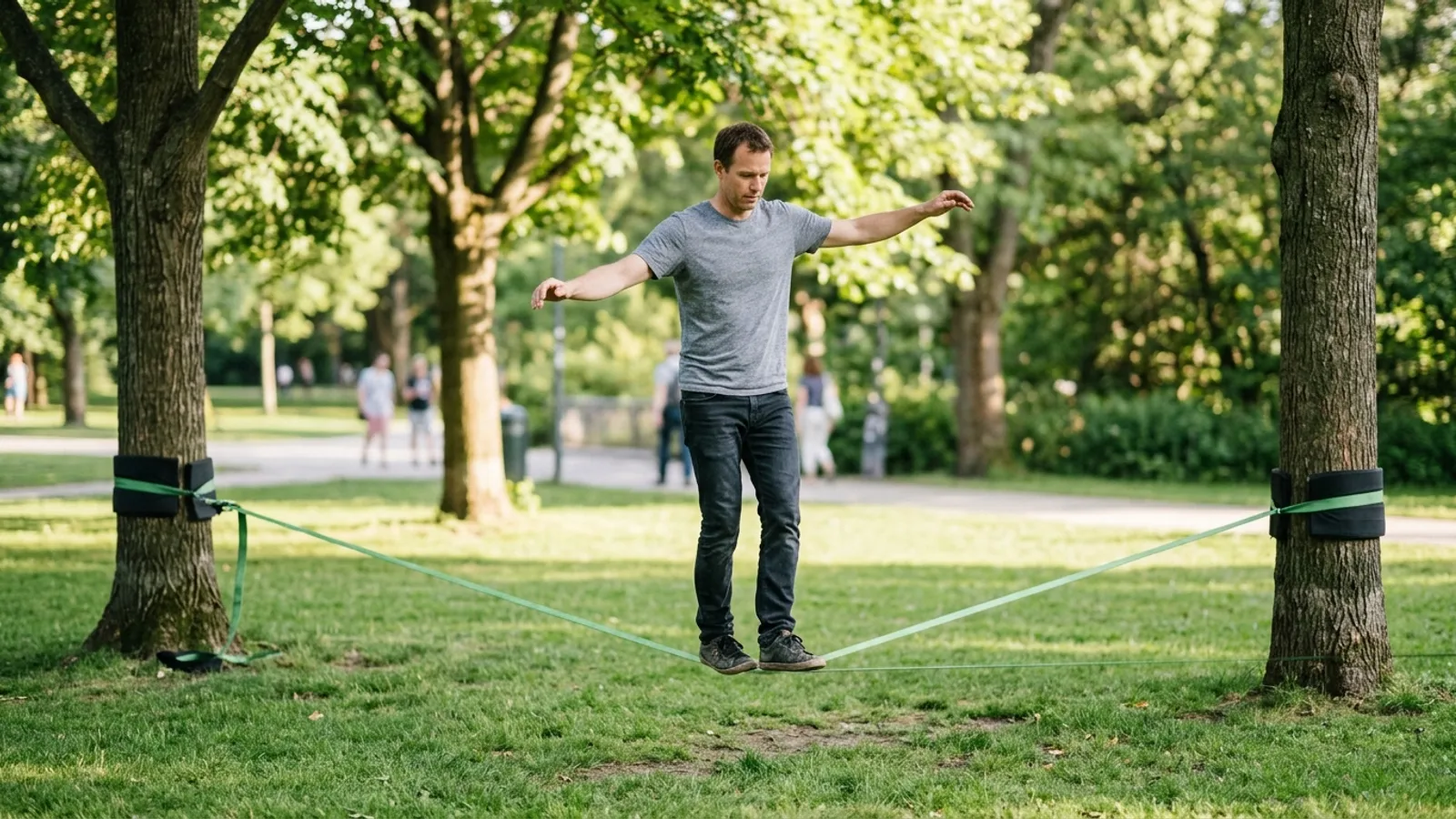
Anyone who wants to train on the line regularly often gets tripped up by a banal problem: two suitable trees the right distance apart. This is exactly where a slackline frame comes in. It’s a free-standing stand that brings its own anchor points along with it – you don’t need a garden full of trees, and you can still practice all year round. In this guide you’ll learn how a frame like this works, what benefits it brings, and what to look for when buying one.
Slackline frame: what’s behind it
At its core, a slackline frame is a sturdy metal stand that you tension the band between. Instead of two trees, two fixed posts take the load. The band runs over a ratchet or tensioning system as usual, except that the anchoring sits in the structure rather than in nature.
Most frames consist of steel or aluminum tubes that are bolted or slotted together. At the bottom, wide base feet, cross-bracing or ground anchors provide stability. Some models are designed to be compact for indoor use, others more robust for the garden and yard.
The crucial difference from a classic setup: height and tension are up to you, not the surroundings. You decide how high the band sits above the ground and how taut it is. That makes the frame especially interesting if you want to train deliberately rather than just balance occasionally.
Functionally, everything stays with the familiar slackline logic: you stand on the band, your body constantly balances out small movements, and it’s exactly this counter-steering that trains the core, feet and deep muscles. The frame doesn’t change the training itself, only the question of what the band hangs from.
Frame, stand or rack – a word muddle
Different terms pop up in shops and forums. “Slackline stand,” “slackline rack” or “slackline without a tree” end up meaning almost the same thing: a free-standing mount. “Frame” has established itself as the most common umbrella term.
What matters is less the word than the build. Pay attention to whether a model is described as a pure indoor solution, an outdoor version, or both – that’s what determines how and where you can use it.
The benefits of going tree-free
The obvious plus: you’re no longer dependent on suitable trees. Anyone who wants to train on the balcony, in the yard, in a hall or in the living room gets the chance to do so at all with a frame. That opens up the slackline to many people who otherwise couldn’t even get started.
On top of that comes repeatability. Trees stand where they stand – sometimes too far apart, sometimes too close, sometimes at an awkward height. A frame gives you the same setup every time. This consistency is worth its weight in gold while learning, because your body can adjust to unchanging conditions.
Another benefit is year-round training. As soon as the weather turns, the outdoor setup often falls away. With an indoor frame you simply shift your balance training inside. Our post on training in winter shows you how to bridge the cold months sensibly.
Finally, time plays a role. A well-rehearsed frame stands in a few minutes. No searching for trees, no debating tree protectors in the park – set up, tension, get going. It’s exactly this low barrier to entry that means you actually train more often.
Last but not least, you’re easy on nature. Without a tree as an anchor, you don’t have to put any strain on trees, and you’re independent of rules in parks or on public land. Your training spot belongs to you – whether on the terrace, in the cellar or in the hobby room.
If you want a flexible setup for indoors and out, it’s worth a look at the free-standing frame for training without a tree. It removes exactly the hurdle that most slackline plans otherwise get stuck on.
What to look for when buying
A frame is a purchase that ideally stays with you for years. It’s worth checking off a few points before buying so the stand really suits your training.
Stability and steadiness
The most important criterion is steadiness. A frame has to withstand the band’s tension and your weight without wandering or tipping over. Look for solid cross-bracing, a wide base and clear figures on the maximum load.
With outdoor models, ground anchors or pegs often provide extra hold in the ground. Indoors, floor weights, sandbags or a heavy build take over this job. Check whether the necessary anchoring elements are included or come separately.
Length, height and band width
Think before buying about what you need the frame for. Short frames are well suited to first standing and balance exercises as well as to cramped spaces. Longer constructions give you room for a few steps and more swing in the band.
Also take a look at the height above the ground and at the band’s width. Wider bands usually feel more comfortable for beginners. It’s important that the frame fits your space – measure beforehand, especially with an indoor slackline frame for the home.
Build quality and material
Look at what the frame is made of and how it’s connected. Bolted joints generally hold up to more than pure slot-in connections, while slotting is faster. Powder-coated steel or anodized aluminum resists weathering and rust better.
A reputable manufacturer gives clear figures on load and material. The DIN 79400 standard, which describes requirements for slackline equipment, can serve as a quality guide. It’s not a must, but a good signal for well-thought-out products.
Transport, setup and takedown
If you want to move or stow your frame often, it’s worth a look at the weight and pack size. Slot-in connections come apart faster, and a dismantlable frame fits more easily into a cellar, cupboard or trunk. Heavier models, on the other hand, usually stand rock-solid but are more unwieldy.
So think honestly about whether your frame stays put permanently or moves around regularly. For a fixed spot in the garden, stability counts; for a flexible indoor slackline frame, easy setup and takedown matter more.
Set or separate?
Some frames come complete with band and ratchet, others as just the frame. If you don’t have any equipment yet, a complete package is more convenient and usually better matched. Anyone who already owns a line can often just add the frame.
If you’re a complete beginner, a classic beginner set for your first attempts can make sense too – for instance if you want to use trees outdoors and stay flexible inside. Anyone who wants to compare the full range can browse the Primeful shop at their leisure.
Setup and safety
A frame is quick to set up, but you should still follow a few ground rules. Safety doesn’t start on the band, but with setting up the frame properly.
Place the frame on level, firm ground. Indoors, a smooth, non-slip floor works; outdoors, compacted or slightly grippy ground. Avoid wet leaves, loose gravel or sloping surfaces where the frame could slide away.
Go through the assembly step by step and tighten all connections firmly. Loose bolts or slot-in parts that haven’t clicked into place are the most common weak point. Before every session it’s worth a quick check: does everything sit tight, is the band undamaged, does the ratchet grip cleanly?
Choosing the right height and surroundings
Start low. A band just above the ground makes getting started much more relaxed, because a step-off is harmless at any time. Increase tension and height only once you feel secure.
Keep the area around the frame clear of furniture, edges and hard objects. Indoors, a mat under the band helps; outdoors, a soft surface like a lawn. That way small wobbles stay harmless.
Learning to step off safely
Anyone who balances also steps back off – ideally in a controlled way. Practice from the start stepping loosely and with slightly bent knees next to the band, rather than falling stiffly. A low band height makes exactly that easy.
You’ll find a detailed step-by-step explanation of tensioning and your first stand in our setup guide. With that you’ll have the basics together before you get going on the frame.
Frequently asked questions
Is a frame as stable as a tree?
A well-built frame reliably carries you and the band tension, but behaves a little differently than a tree. It can flex slightly or work a bit during very dynamic exercises. With sufficient anchoring and a solid frame, that’s no problem for normal fitness and balance training.
Can I use a slackline frame in my apartment?
Yes, there are models designed specifically for indoor spaces. Pay attention to the dimensions, a non-slip footing and enough room all around. A mat under the band protects the floor and cushions small step-offs.
Roughly what does a frame cost?
The price depends heavily on size, material and features, so there’s no blanket figure. Compact indoor frames usually sit below larger outdoor constructions with anchoring. It’s best to compare specific models and their load figures.
Do I need additional anchoring?
That depends on the build and where you use it. Many outdoor frames rely on ground anchors, while indoor versions are stabilized by weight or a wide base. Before buying, check what’s included and what you may need to add.