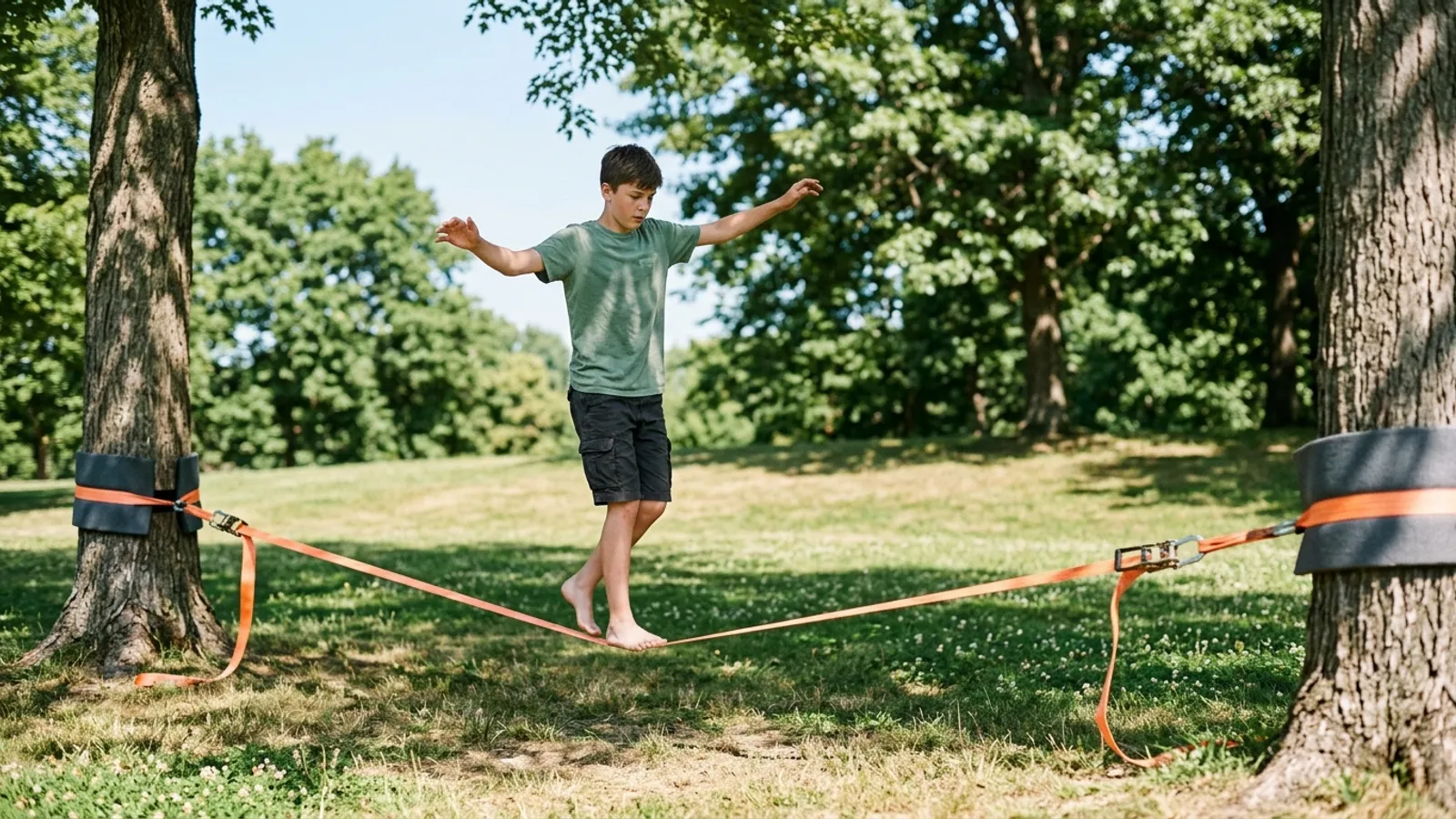
When a foot slips on wet leaves or you briefly lose your balance on the stairs, a tiny moment decides whether you stumble or catch yourself. This is exactly where slackline fall prevention comes in: on a flat line you train the small, fast corrections that make the difference in everyday life. It’s not about acrobatics, but about standing securely and a reliable feel for your body.
In this article you’ll read why it works, what happens in your body, and which gentle exercises to start with – step by step and without pressure.
Slackline fall prevention: why it works
A fall rarely begins with the fall itself. It begins with a moment when your body reacts too slowly, your center of gravity drifts too far out, or a joint doesn’t counter-steer fast enough. People who train these reactions catch themselves earlier – often before the wobble even turns into a stumble.
The slackline is a surprisingly honest tool for this. The band gives way beneath you and swings slightly, so you have to keep readjusting. Your nervous system learns to spot small deviations in a flash and balance them out with the right muscles. That’s exactly the ability you need on cobblestones, in a dark hallway, or when stepping off the bus.
The advantage over firm ground: on solid footing you eventually just “stand.” On the line you get dosed, controlled instability – a stimulus that noticeably challenges your balance without being dangerous. You practice catching yourself while you can still do it relaxed in a safe setting.
What matters is the basic mindset: fall prevention here means small, frequent, low stimuli – not the courage for great heights. A line just above the ground, a firm support within reach, and calm practice do more than any reckless attempt.
Balance, reaction, and strength
Steadiness is built from three components, and the line trains all three at once.
Faster reaction and body awareness
On the line your body constantly delivers feedback: where am I right now, which way am I tipping, which muscle has to tense now? This perception through joints and muscles is called proprioception. The better it works, the sooner you notice that you’re getting off balance – and the faster you correct. In everyday life that means: you catch yourself instead of falling.
Stable ankles and knees
Many falls start at the foot. If you roll your ankle, the reaction time of the surrounding muscles decides whether you catch yourself. On the line, the ankle, calf, and small foot muscles work along permanently. Your knee also learns to stay cleanly over your foot instead of tipping inward. That makes you more reliable on uneven ground.
Trunk and leg strength as an anchor
Your trunk is the center from which every correction starts. Abs, back, and hips stabilize while the legs hold the center of gravity. This interplay of strength and control is what carries you in the decisive moment. People who get stronger and quicker to react here stand noticeably more securely in everyday life.
How these components together make a strong core and better balance is explored in depth in our Slackline Fitness Guide. If you want to approach the topic specifically for older adults, read the complementary Slackline for seniors.
Gentle exercises to get started
Start low and slow. Tension the line as low as possible – ideally just a few centimeters above the ground, so you can step down comfortably at any time. Hold on to a wall, a railing, or a helping hand at first. Practice without shoes or with flat, grippy soles, so your foot can work along.
First stand, then balance
Begin with a single-leg stand next to the line: stand on firm ground, lift one foot slightly, and hold for ten to twenty seconds. This activates the muscles you’ll need on the band in a moment.
Then step one foot onto the line, the other stays on the ground. Feel how the band gives way slightly and find a calm stance. Switch sides. Even this stimulus sharpens your balance.
Hold, release, walk
When the single-leg stand feels secure, place both feet one behind the other on the line, support within reach. The goal isn’t standing still, but calmly balancing out the small wobbles.
Next, briefly let go of your support – just for a second or two – and grab on again. This is how you get used to stabilizing yourself. Only after that come small steps along the band, always with support nearby.
Control instead of speed
Three short sessions a week of ten minutes each do more than one long, exhausting attempt. Fatigue worsens your balance – end a session while you’re still focused. Small, regular stimuli are the heart of any good fall prophylaxis.
For starting at home, a solid beginner set is enough. If you want to practice on firm footing and low tension, the matching beginner set for safe balance training has everything you need, including ratchet and tree protectors. With your equipment, look for tested quality – the German standard DIN 79400 is a good orientation for solid slackline gear.
Training safely
Safety decides whether training becomes real fall prevention. Keep the line low and provide a soft, obstacle-free surface – grass, a mat, or soft forest floor. Clear away stones, edges, and tripping hazards before you start.
In the first weeks, never practice without support within reach. A stable wall, a railing, or a second person give you the security to focus fully on your balance. Step down in a controlled way as soon as you get tired or your concentration slips.
If no tree or fixed anchor point is available, you need no garden and no trees: with a sturdy stand for indoors and out you set the line up on a firm frame and train all year round – even in winter in your living room. That lowers the barrier to entry and makes regular practice realistic.
A clear note on health: with dizziness, known balance disorders, after injuries or surgery, talk to your doctor first. With conditions that affect your balance, a quick check-in is also sensible. Slackline training can support steadiness, but it doesn’t replace medical treatment and is no miracle cure. Listen to your body and build up slowly.
If you want to firmly build the training into your everyday life, you’ll find further accessories and complete solutions to browse the Primeful shop and choose the right set for your own situation.
Frequently asked questions
Does a slackline really help against falls?
The line trains reaction, balance, and leg strength – exactly the abilities that make you more secure in everyday life. It can improve the quality of your steadiness and sharpen your body awareness. There’s no guarantee against falls, but regular balance training is considered a sensible component of fall prophylaxis.
How low should the line be tensioned?
As low as possible, especially at the start. A few centimeters above soft ground is plenty to challenge your balance without building a real fall risk. Low and controlled is always better here than high and bold.
How often should I practice?
Short and regular works best. Two to three sessions a week of ten minutes each are a good start. End each session while you’re still focused, because fatigue worsens your balance.
Is this also suitable for older adults?
Yes, with a low line, firm support, and a calm pace, gentle balance training adapts well. With dizziness, balance disorders, or after injuries, medical advice should be obtained first. You’ll read more about this in the linked article on the slackline for seniors.