Slackline for Back Pain: What’s Behind It
Whether a slackline for back pain really helps is something a lot of people wonder when they get up from their desk in the evening with a tense lower back. The honest answer: the line is no miracle cure, but it trains exactly the muscles that keep your back stable. And it does so in a way that doesn’t feel like therapy, but like play.
The bulk of our back complaints are non-specific. That means: there’s no serious injury behind them, but often too much sitting, too little movement and a weak deep musculature. This is exactly where balance training comes in.
When you stand on a narrow, swinging band, you constantly get slightly off balance. Your body corrects that in a flash – through small, deep-lying muscles around the spine and pelvis. This constant counter-steering is training, without you experiencing it as effort.
One important note up front: with acute, severe or radiating pain, you don’t belong on the line, but at the doctor or in physiotherapy. Slacklining is supportive training for a healthy or slightly tense back – not a treatment.
Why the Line Balances Out Everyday Life
Sitting isn’t the problem for your back, but sitting too long in one stretch is. Over hours in the same posture, the hip flexors shorten at the front while the core muscles slacken at the back. Your posture gets out of alignment.
The slackline forces you into the upright counter-movement. You stand tall, your gaze goes forward, your spine straightens up. Even a few minutes a day set a stimulus that pushes back against hours of sitting.
The Role of the Deep Muscles
When people talk about the back, many think of the visible large muscles. But what’s decisive for stability is the deep musculature – small muscles that attach directly to the spine and pelvis and hold them together like an inner corset.
These muscles can barely be targeted with classic weights. They respond to instability: as soon as the surface wobbles, they switch on automatically to align you. That’s exactly the core of balance training.
What Happens When You Stand on the Line
Imagine you’re standing with one foot on the band. It swings to the left – small muscles on the right tense immediately to pull you back. It tips forward – your core reacts. This game runs hundreds of times per minute, completely unconsciously.
Over time, your nervous system learns to react faster and more finely. This improved control is called proprioception – the body sense of where your joints are in space. A well-connected, quick-reacting core absorbs everyday loads better, for example when you bend down or lift a crate of water.
If you’re curious about which areas specifically do the work, read our overview of which muscles are working. In short: it’s much more than just the abs.
Improving Posture as a Side Effect
A strong deep musculature carries you more upright, without you having to consciously “sit up straight.” The straightening happens from the inside, because the stabilizing muscles reliably do their job again.
Many report after a few weeks that holding an upright posture comes easier and their lower back twinges less in the evening. Those are anecdotal experiences, not guaranteed results – but they fit well with what balance training can do biomechanically.
Exercises for a Strong Back
You don’t need acrobatic tricks. For the back, what counts are calm, controlled exercises that challenge the deep muscles. Keep the line low – ankle to knee height is plenty – and work barefoot, which improves the feel in your feet.
Upright Stand
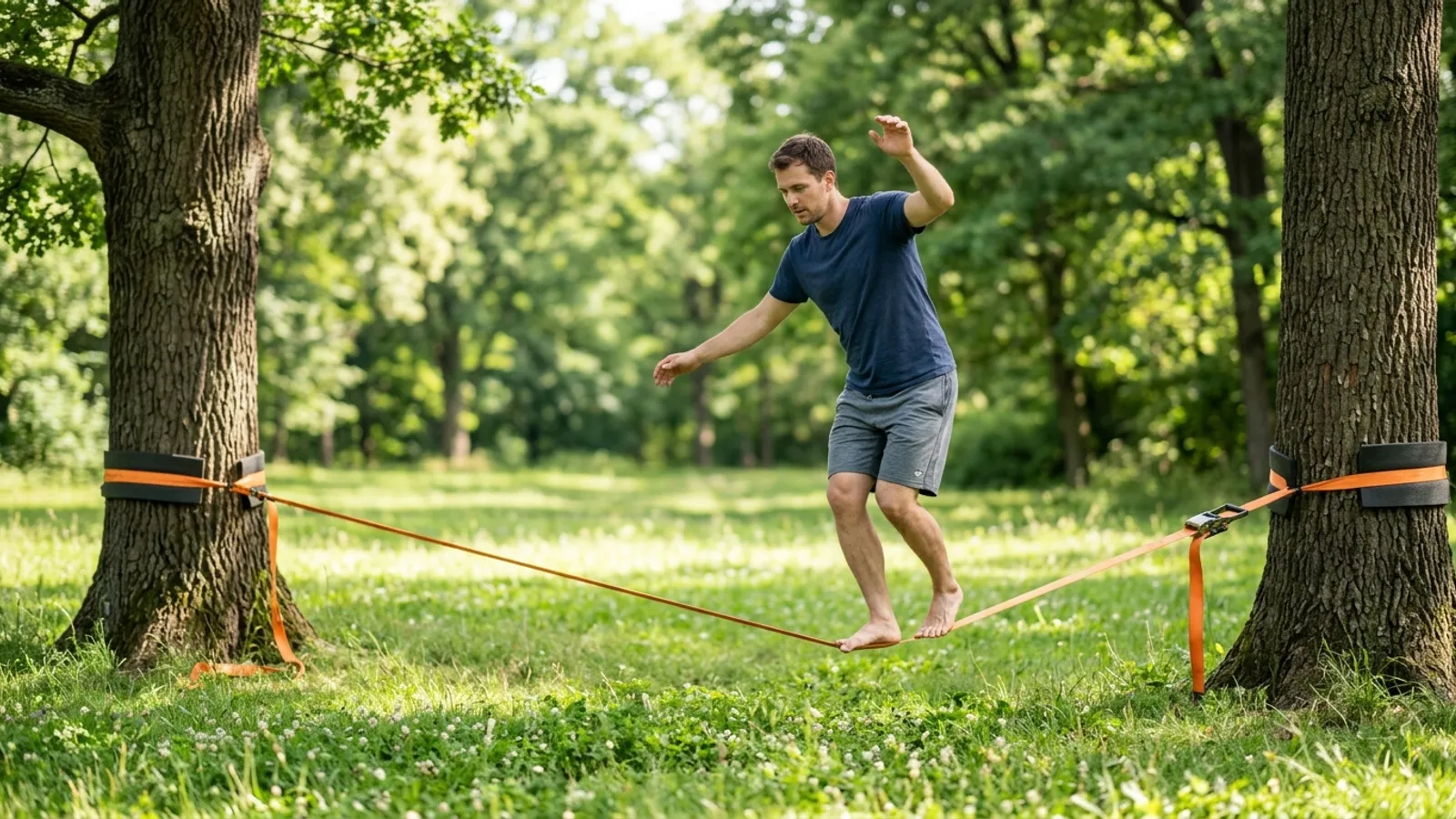
Step onto the band with one foot, your gaze fixed on a firm point at eye level in front of you, not on the ground. Arms loosely raised, sternum slightly forward and up. Feel how your core straightens up.
Hold the stand as long as it stays calm, then switch sides. Even 30 seconds per leg, several times a day, are a good start. Quality over duration – the moment you tense up, take a break.
Two-Leg Stand with a Small Squat
Once the single-leg stand works securely, place both feet lengthwise on the band. Slowly bend a few centimeters into your knees and back up, keeping your back long and upright. This mini-squat activates the core and pelvic stability at once.
Light Scale Pose
Stand on one leg and tip your upper body minimally forward while your free leg goes slightly back – only as far as you keep control. This movement challenges the rear chain along the spine. Hold it briefly, return in a controlled way.
Conscious Breathing While Standing
Sounds unspectacular, but it’s effective: stand calmly on the line and breathe deeply into your belly. The diaphragm works together with the deep muscles and stabilizes from the inside. A few calm breaths in balance also ease the often pain-amplifying tension.
For these exercises to succeed safely, a stable, cleanly tensioned set is decisive. For getting started, a complete beginner set with a ratchet and tree protectors is well suited, letting you set the band up low and without sag. When choosing, watch for quality – the DIN 79400 standard is a helpful reference for solid equipment.
What You Should Keep in Mind
As good as balance training can be for the back – a few things decide whether it helps or rather irritates. Approach the matter patiently, your body awareness builds over weeks, not days.
See a Professional First for Real Complaints
This is the most important point: with acute, intense or longer-lasting back pain, with radiation into the leg, numbness or after a fall, you go to the doctor or physiotherapy first. The slackline replaces neither a diagnosis nor a treatment. Only once you have the green light is it a sensible building block.
Start Low and Spot Yourself
Tension the band ankle to at most knee height, so you can step off safely at any time. Make sure the ground is soft and free of obstacles – grass or a mat. In your first attempts, a second person you can briefly hold onto helps, or a stable point within reach.
Train Indoors and Out
Back routines only work if you stay consistent – and in everyday life that’s often the real hurdle. A garden with two trees is nice, but not everyone has one, and in winter the line stands still anyway. With a freestanding frame, you set the slackline up indoors or on the terrace, completely without a tree.
That turns the occasional summer fun into a year-round stimulus for your back. If independence from the garden matters to you, it’s worth a look at a slackline frame for indoors and without a tree – ideal precisely for short, regular sessions in the evening.
Build It Into Everyday Life
Three to five minutes on most days do more than one long session per week. Put the line where you see it, and use it as a movement break between blocks of sitting. Feel free to combine it with regular back training or walks.
You’ll find a complete progression from beginner to advanced in our slackline fitness guide. If you want to complete or compare your setup, you can browse in the Primeful shop at your leisure and find the right material for your space.
Frequently Asked Questions
Does a slackline help with acute back pain?
No. With acute, severe or radiating pain, you shouldn’t train, but have a doctor or physiotherapist clarify what’s behind it. The slackline is intended as preventive and supportive training for a healthy or slightly tense back – not as a treatment in an acute case.
How often should I get on the line for my back?
Better short and regular than rare and long. Three to five minutes on most days are plenty for the start, because the constant counter-steering alone sets a training stimulus. More important than duration is that you stay consistent and work cleanly, without tensing up.
Do I need a special slackline for back training?
No, a solid, low-tensioned beginner line is enough. Watch for good construction and a reliable ratchet; the DIN 79400 standard is a reference here. If you have no tree or want to practice indoors in winter, a freestanding frame is the more practical solution.
Does slacklining really improve posture?
It can support posture, because the strengthened deep musculature carries you more upright from the inside. Many feel their posture is more relaxed and stable after a few weeks – those are anecdotal experiences, not a guarantee. As part of an active everyday life with enough movement, though, the line is a sensible building block.