You want to train your balance and you’re facing the question: slackline vs balance board? Both pieces of gear challenge your balance, but they do it in very different ways. This comparison shows you honestly what each tool can do, where it falls short and which one suits your space, your budget and your goal better.
Yes, we sell slacklines. Even so, you won’t get any sugarcoating here, but a fair side-by-side. By the end you’ll know which balance trainer makes sense for you.
Slackline vs balance board: the quick overview
In short: the balance board is compact, ready to use right away and mainly trains your ankles and core in one spot. The slackline is more dynamic, brings walking and full-body stabilization into play and is simply more fun for many people.
A balance board is usually a board on a roller, a half-sphere or a cushion. You stand on it and hold the center. The movement is small, controlled and always in the same place.
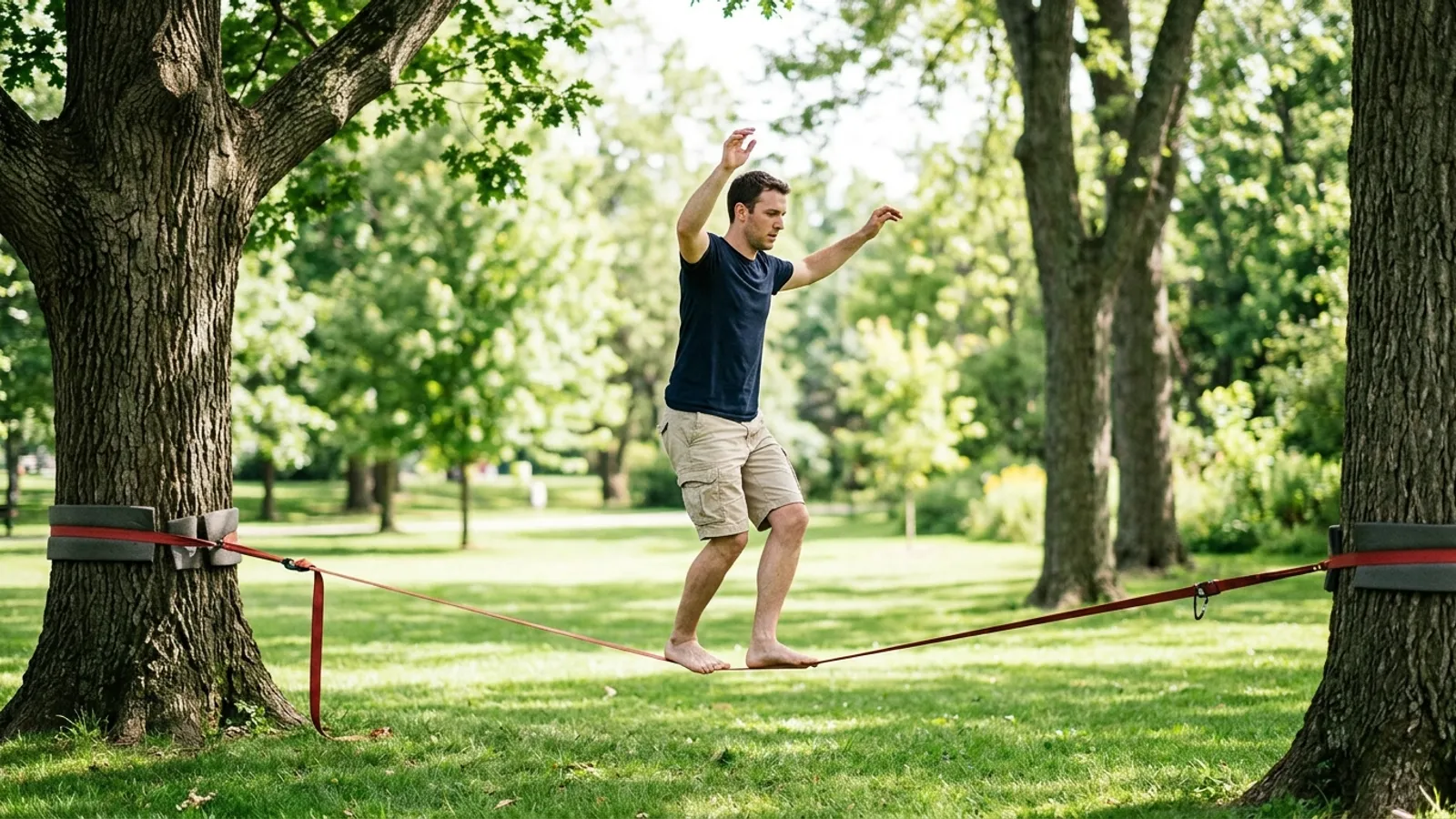
A slackline is a band tensioned between two fixed points – trees or a frame. It sways in several directions at once. You don’t just balance, you also move forward and constantly correct yourself.
The two types of training
Picture the balance board as a static anchor: one point, many small corrections. The slackline is more of a journey: it moves you through space and forces your whole body to work along.
Both train proprioception – your sense of where your body is in space. But the stimulus is different, and that’s exactly what makes the comparison interesting.
One practical difference: on the board you can prop yourself up with one foot in a pinch without breaking off. On the line there’s no such little pause – every second demands active control. That makes the line more exhausting, but also more instructive for the whole body.
Training effect in comparison
This is where the real difference between the two pieces of gear lies. Let’s look at what each trainer actually engages.
What the balance board can do
A wobble board is strong when it comes to isolated stabilization training. The ankles work intensively because the board tilts constantly and you have to counter immediately. That’s useful after ankle injuries or as a rehab supplement.
The core gets some of it too, especially the deep abdominal muscles. You can easily put the board in front of the TV and practice a few minutes on the side. The learning curve is flat: most people manage to stand in the first session.
The downside: the stimulus stays small and quickly becomes familiar. As soon as you stand securely, you have to challenge yourself with extra exercises or harder boards, otherwise the effect stagnates.
Because the movement stays confined to one spot, leg coordination and gait muscles barely play a role. The board can’t deliver that either – it isn’t built for it. It remains a precise tool for a clearly defined purpose.
What the slackline can do
The slackline challenges far more muscles at the same time. Because the band sways in every direction, your entire core, your hips and even your arms and shoulders have to keep counter-regulating. This is full-body balance, not an isolated ankle drill.
On top of that comes movement through space: first stand, then a step, then walk. This progression keeps training interesting over months and constantly delivers new stimuli. That’s exactly why many people find the line the more effective balance training.
But let’s stay honest too: the entry is more demanding. The first attempts wobble a lot, and not everyone gets two steps far right away. This hurdle is part of it – and it’s precisely what creates the big training stimulus.
If you want to dig deeper into how the line trains core and balance together, take a look at our Slackline Fitness Guide. There you’ll find concrete exercises from the stand to the squat on the band.
The verdict on training effect
For targeted ankle rehab or short mini-sessions in between, the board is practical. For versatile, motivating full-body training that challenges you long-term, the slackline is ahead. It combines balance, coordination and body tension in one movement.
Space, setup and price
Beyond the training, everyday life often decides which piece of gear suits you. Here lie the biggest practical differences.
Space requirements
The balance board clearly wins on space. It fits in any corner, under the sofa or on the shelf. You only need an arm’s length of free space around you, nothing more. For small apartments that’s a real plus.
The slackline needs more distance. In the garden, two stable trees at the right spacing are enough. Indoors or without a tree, you need a frame that occupies a fixed length in the room. On the upside, a line can usually be rolled up to save space after training.
Setup and spontaneity
For setup, the board scores again: lay it down, step on, done. No preparation, no ratcheting.
The slackline needs a few minutes to tension. With a little practice it goes quickly, but it’s a deliberate step. Anyone who wants to train without trees or practice indoors all year is well served by a slackline with a frame for indoors and outdoors – it stands stable and can be set up flexibly.
This little extra effort has an underrated advantage, by the way: the deliberate setup creates a training start. You commit to the session instead of just hopping on briefly. For many people, exactly that feels more motivating than a piece of gear that’s always lying around.
Price
On money we deliberately stay qualitative – daily prices change constantly. In general, simple balance boards are often cheaper to buy than a complete slackline set, because less material is needed.
A slackline usually costs a bit more, but in return offers more training variety for the money and lasts a very long time with good quality. With both, look for solid construction. For slacklines, the DIN 79400 standard gives guidance for tested quality.
If you first want to start on a manageable budget, it’s worth a look at a beginner set with band and ratchet. With it you cover the complete basic training. You’ll find more variants if you’d like to browse the Primeful shop.
What suits you?
There isn’t one single best piece of gear, but the best one for your situation. Go through the following points honestly.
Choose the balance board if …
- you have very little space and want to practice indoors in tight quarters.
- you want to stabilize your ankles specifically after an injury.
- you prefer short, spontaneous mini-sessions on the side.
- a flat, fast entry is important to you.
The board is the uncomplicated choice for spot-focused stabilization training without setup.
Choose the slackline if …
- you want varied full-body training that stays motivating for a long time.
- progress and a real progression are important to you.
- you enjoy movement and a small challenge.
- you have space in the garden or can set up a frame indoors.
The slackline is the right choice if you understand balance as versatile, motivating training and not just as a short exercise.
And if both appeal to you?
Many people combine both: the board for quick sessions during the week, the line on the weekend for the longer, full-body training. This mix covers both types of training and rarely gets boring.
If you can only buy one and you’re unsure, ask yourself what motivates you more: a piece of gear you use daily on the side, or one you experience as a little adventure. Honesty at this point usually decides more about your success than the raw training data. The best piece of gear is the one you actually use.
If you decide on the line, our guide on which slackline suits beginners helps you with band width, length and set selection. That way you start with the right material instead of frustration.
Frequently Asked Questions
What’s easier for beginners, slackline or balance board?
The balance board is easier at first because you only have to hold one point and can usually stand right away. The slackline takes more patience in the first sessions. In return, the training stimulus on the line is greater and lasts longer.
Do both train the same effect for balance?
Both improve proprioception and stability, but differently. The board focuses on ankles and core in one spot, the slackline challenges the whole body including movement through space. For versatile balance, the line is more broadly positioned.
Can I use a slackline without trees and without a garden?
Yes. With a frame you set up the line freely in the room or in the garden, completely without trees. That way you train all year, even indoors in bad weather. This makes the line much more flexible than many people initially think.
Is the slackline’s greater effort worth it at all?
If variety and long-term motivation are important to you: yes. The slightly bigger setup and the steeper learning curve pay off through more versatile training and more fun. For pure mini-sessions in between, the board remains the more pragmatic choice.