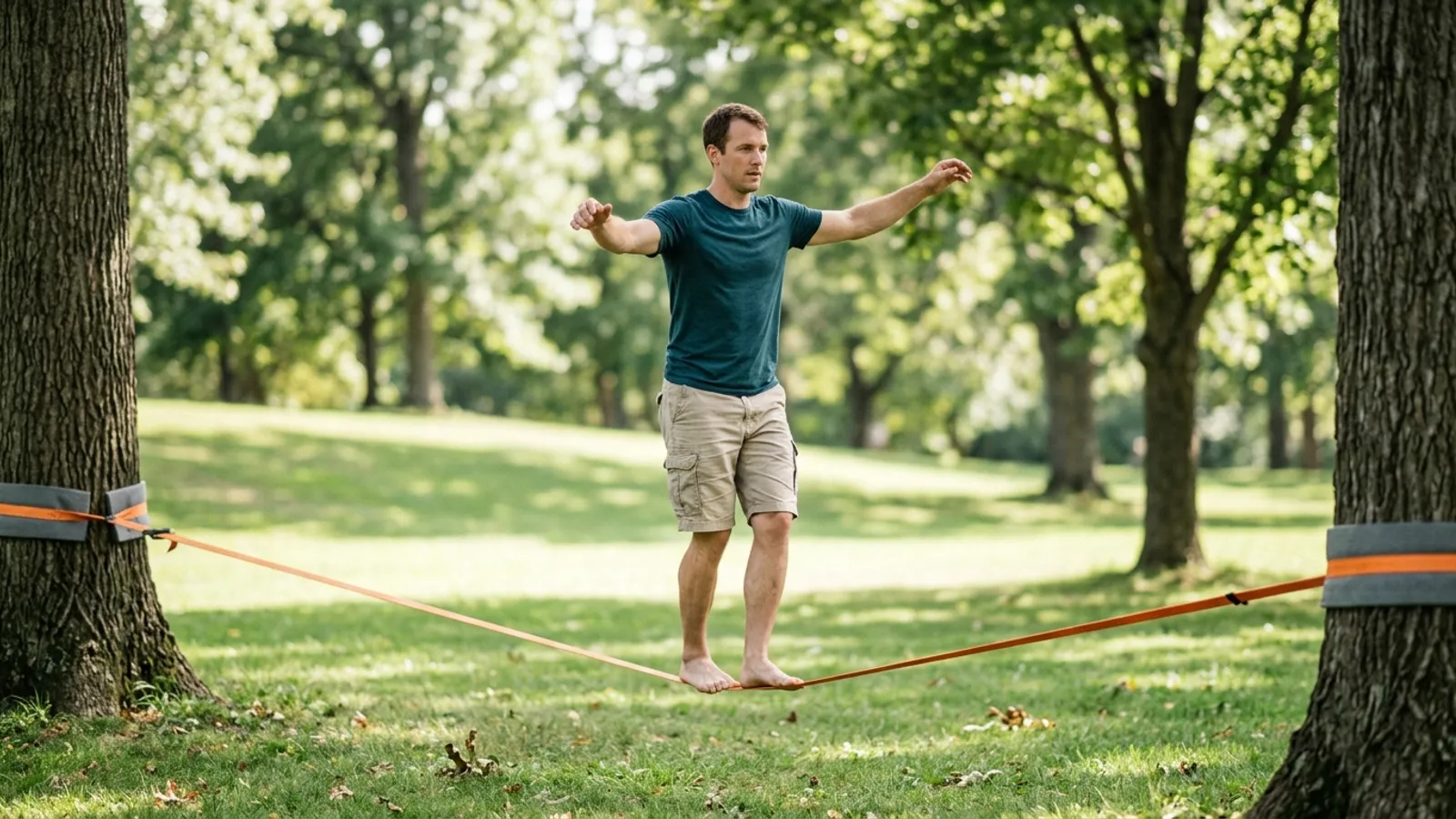
Slackline muscles: the full-body effect
The first time you stand on the line, you probably wonder: which slackline muscles are actually working this hard right now? The short answer: almost all of them. Because the band constantly gives way beneath you, and your body has to balance out those small wobbles millisecond by millisecond.
That’s exactly what makes it so engaging. On the slackline you don’t train individual muscles in isolation like on a weight bench. You train an interplay: feet, legs, core, arms, and even the fine stabilizing muscles along your spine all work at the same time.
This is called movement patterns rather than single muscles. Your nervous system coordinates which muscle counter-steers when and how strongly. That’s why, after your first attempts, you often feel sore in places you’ve hardly ever noticed at the gym.
In this overview we go through the muscle groups one by one – from the sole of your foot to your shoulder. That way you understand what really happens when you balance, and you can train more purposefully. If the training side interests you more, take a complementary look at the Slackline Fitness Guide.
Core and trunk as the center
If there’s one region that works hardest while slacklining, it’s your trunk. The core is the link between your upper and lower body – and on the wobbling line, all the stabilization comes together here.
Deep muscles and the rectus abdominis
What’s especially interesting is the deep musculature. The transverse abdominal muscle (transversus abdominis) and the small muscles right at the spine (multifidi) keep your spine stable without you consciously activating them. They react reflexively to every wobble.
These deep layers are hard to reach in classic strength training, because they aren’t responsible for big movements but for holding. On the line they get exactly the stimulus they need: constant, fine-tuned counter-steering.
The rectus abdominis and the side abdominal muscles (obliques) kick in additionally as soon as your upper body tips to the side. They pull you back into the center. That’s why, when it comes to the slackline core, many people quickly feel that their midsection is much more active than expected.
The difference from a crunch is big: in a classic crunch you move your upper body against a firm floor. On the line, by contrast, your trunk stays largely still and works mainly to keep from tipping or rotating. This so-called anti-movement is exactly what protects your spine in everyday life.
Back and hip stabilizers
Your lower back is involved too. The back extensor (erector spinae) keeps you upright and works closely together with the abdominal muscles. This front-and-back team makes sure you don’t fold forward or backward.
Add to that the hip stabilizers, above all the gluteus medius. It keeps your pelvis from dropping to the side. This very interplay of trunk and hip is what makes balancing so valuable for a stable midsection in everyday life.
The nice thing about it: you don’t have to address these muscles one by one. As soon as you stand on the band, your body organizes the interplay itself. You only set the task – stay standing – and your trunk solves it through countless small corrections.
Legs, feet, and glutes
Beneath your trunk, your legs carry the main load – and they do more than just hold you up. They cushion, correct, and stabilize without pause.
Thighs and glutes
Your front thigh (quadriceps) is called upon as soon as you bend your knees slightly. This slight bend is your base position on the line, because it gives you a lower center of gravity. Hold it for seconds and the quadriceps keeps working continuously.
On the back side, the rear thigh muscles (hamstrings) and the large gluteal muscle come into play. They stabilize hip and knee and keep your standing leg from buckling. The big slackline legs team of front and back works here like a shock absorber.
Calves and foot muscles
Especially underrated is everything below the knee. Your calves (gastrocnemius and soleus) constantly regulate balance via the ankle. They’re often the first area to tremble in beginners.
Even finer is the work of the small foot muscles. The muscles in the sole and around the ankle practically grip the band and correct tiny tipping movements. You feel this most clearly barefoot, because your foot then gets maximum feedback.
These small foot and calf muscles in particular get hardly any stimulus in everyday life inside firm shoes. On the line they’re fully challenged again – one reason the training also has a positive effect on general steadiness. A stable ankle is the basis for almost every standing movement.
This proprioceptive work – that is, the perception of your joint position – is one of the biggest plus points. If you’re curious how this plays out long-term, read how healthy slacklining is.
For your first steady standing attempts, a solid beginner set is enough. A short, well-tensioned band makes the start noticeably easier – check out the beginner set with ratchet.
Upper body, arms, and posture
Even though the legs carry the load, your upper body is anything but passive. It steers your balance through its position and through your arms.
Arms as a balancing aid
Your arms work like a living balancing pole. Shoulder, arm, and neck muscles work constantly to hold your balance through small arm movements. That’s less about strength work and more about fine control, but it adds up.
At first most people windmill a lot with their arms. That’s completely normal and part of the learning process. Over time the corrections get smaller and the work shifts more into the trunk.
Shoulder girdle and postural muscles
More important than pure arm strength are your postural muscles. The shoulder girdle, the upper back muscles, and the neck keep your upper body upright and aligned. They make sure you don’t collapse into yourself but form a long, stable line.
These very muscles suffer from long sitting in everyday life. On the line they get a useful counter-movement, because an upright, open posture makes balancing easier for you. So you train posture not as an exercise but because it’s functionally necessary.
As soon as push-up or support variations come in, the chest, triceps, and shoulder girdle chime in additionally as strength work. Then pure balance turns into full-fledged strengthening training for your upper body.
The order matters: first comes safe standing, then movements with your legs, and only after that support exercises. If you take on a lot of load with your arms too early, you tend to tense up your neck and shoulders rather than strengthen them usefully. Give your body the time to find balance first through your feet and trunk.
How to train on purpose
You don’t have to leave everything to chance. With a few simple levers you control which slackline muscles get challenged more strongly – and build strength and stability step by step.
Levers for more stimulus
- Band tension: A taut band is more stable and ideal for getting started. If you leave it a bit looser, it wobbles more and challenges feet and core much harder.
- Barefoot instead of shoes: Without shoes your foot muscles work more intensely, because they have direct contact and more feedback.
- Holding time: Hold positions deliberately for several seconds. That way you switch from short corrections to real holding work for legs and trunk.
- Movement while standing: Small squats, a raised leg, or a turn deliberately shift the stimulus onto glutes, thighs, or the side abdominal muscles.
Progression with sense
Go in small steps. First stand safely, then walk, then add exercises. If you overload the muscles, you mostly end up frustrated – and progress comes anyway from regular, short sessions.
Plan three short sessions a week rather than one long one. Your deep muscles and nervous system learn through repetition, not through single marathon sessions. Even ten to fifteen minutes are enough at the start.
Keep in mind that most of the early progress happens in your head: your nervous system learns to activate the right muscles at the right moment. That’s why you often feel more secure after just a few sessions, even though the muscles themselves have hardly grown. Noticeable strength comes afterward, with regularity.
With your equipment, look for solid quality. For permanently built setups, the DIN 79400 standard can serve as a reference for tested slackline gear – especially if you want to set up without trees. A sturdy construction makes the training plannable, indoors and out: check out the slackline with a stand.
If you’d like an overview of suitable sets and accessories, take your time to browse the Primeful shop and choose the setup that fits your goal.
Frequently asked questions
Which muscles will I feel the next day?
Usually it’s your calves, foot muscles, and the deep trunk muscles. These areas work almost continuously while balancing but are rarely challenged like this in everyday life. A slight pull is normal and eases off as you get used to it.
Does the slackline really train the core?
Yes, and especially the deep, stabilizing layers. Because the band constantly gives way, your trunk has to counter-steer permanently without you consciously activating it. That’s exactly the stimulus that makes your midsection more stable.
Will I also build visible muscle on the line?
Slacklining is primarily stability and coordination training, not classic muscle building like with weights. You gain mainly control, posture, and deep strength. Visible effects depend heavily on the rest of your training and your nutrition – firm promises would be unserious.
Do I need prior experience or a certain level of strength?
No. Most adults can start without any prior knowledge, because you control pace and difficulty yourself. Begin with short standing attempts at a fixed support and build up as soon as you feel secure.