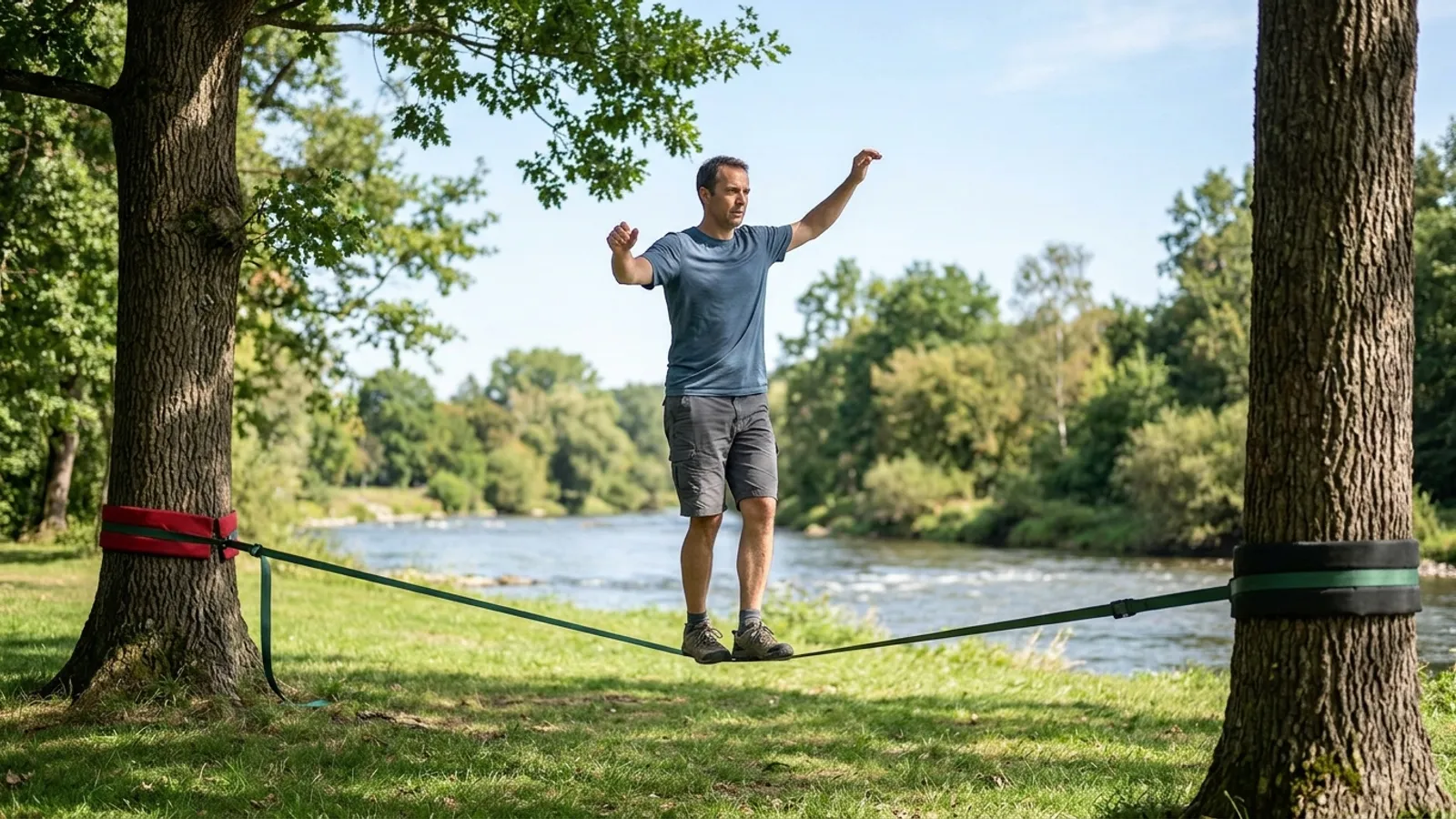
Is slackline healthy? The short answer: yes – as long as you approach it sensibly. The narrow band trains your whole body, sharpens your balance, and clears your head along the way. Here we honestly lay out what’s behind it: what happens in your muscles and joints when you balance, why the line is good for posture and focus – and what to watch for so the training stays safe.
Is slackline healthy? The honest answer
For the vast majority of healthy adults, slacklining is a very healthy form of training. You challenge balance, core, and coordination all at once, without putting heavy strain on your joints – the band gives way and cushions every step. That combination is exactly what makes it so valuable: a lot of training stimulus, little impact.
What matters is framing it correctly. Slacklining doesn’t replace a complete strength or endurance program, and it’s no miracle cure either. It’s an excellent supplement for balance, stability, and body awareness. If you have an acute injury or feel unsure, get it checked by a doctor first – otherwise the rule is: low tension, slow progression, stay consistent.
What happens in your body when you balance
The moment you stand on the band, a constant, fine-tuned counter-steering begins. Your nervous system processes information from your feet, joints, and eyes in a flash and triggers the tiniest muscle corrections – this perception is called proprioception. It’s the foundation for safe movement in everyday life and in sport.
Unlike on a machine, it’s not a single muscle working here but a whole network. The deep core muscles stabilize your pelvis, your leg muscles react to every wobble, and even the small muscles in your feet kick in. So you train movement patterns rather than isolated muscles – and that’s exactly what carries over well into everyday life.
A welcome side effect: because the band gives way, the load on your knees and ankles stays nicely controlled. You can adjust the intensity at any time through difficulty and duration, rather than through weight.
Over time, this interplay becomes more and more efficient. What looks like frantic trembling at the start turns into calm, small corrections – a visible sign that your nervous system is learning. This very learning process is what makes slacklining so effective and at the same time so engaging: you feel your progress from session to session, which makes it easier to stick with. Along the way, your body builds a more precise inner picture of where it sits in space – and that helps with all kinds of everyday movements too.
Strong for your back, joints, and posture
A wobbling band forces you to straighten up and find your center. That’s exactly what’s missing for many people who sit a lot. With every session you train the muscles that stabilize your spine and learn to stand upright and relaxed.
Your joints benefit too. Ankles and knees learn to react quickly and in a controlled way to small disturbances – a skill that, in everyday life, protects against the classic rolled ankle and adds more safety in sport. We’ve broken down exactly which muscle groups are at work, step by step: take a look at which muscles the slackline trains.
If you want to use the line specifically as a full-body workout, you’ll find a complete exercise series in the Slackline Fitness Guide – from your first stance to strength exercises.
The best part: these effects show up even without hours of training. Regular short sessions are already enough for your posture and steadiness to improve noticeably. You don’t need perfect technique to benefit – simply holding your balance is already a stimulus your body answers with more stability.
Good for your mind: focus and stress relief
Balancing only works with attention. The moment you stand on the line, there’s no room left for brooding – you’re in the here and now. Many experience it as a little time-out: your gaze settles forward, your breathing calms down, and your mind concentrates on a single task.
This focus is trainable and it carries over. People who practice regularly often notice that staying on task elsewhere gets easier too. On top of that comes the simple sense of achievement: every extra step, every second longer in the stance is motivating. So slacklining is healthy not just for your body, but for your mood as well.
You probably already know that moving outdoors does you extra good. Slacklining combines both – concentration and fresh air. And even if you practice indoors, the mental effect remains: a few minutes fully focused on one thing is a small, effective break for your head.
Who benefits most from slacklining
Almost everyone benefits in principle – but for some groups the line is especially valuable. If you sit a lot, short balance sessions give you an effective counterweight to desk life: the line straightens you up, activates your center, and brings movement into an otherwise static day. Even a few minutes here and there release tension and pull you out of that constant seated posture.
Athletes get added value too. Runners, ball-sport players, and winter-sports athletes improve their stability and reaction speed with balance training – skills that carry over directly to their own sport. And if you want to ease back in after a long break, the low-tensioned line offers a gentle, joint-friendly return that you can build up step by step.
Even in later years the training makes sense, as long as you take it slowly and hold on at first. Especially then, the steadiness you’ve trained pays off in everyday life – walking safely, climbing stairs, and avoiding falls. The same principle applies to every group: start low, practice in short, regular sessions, enjoy the progress.
Starting safely and healthily
For the training to stay healthy, the setup matters most. Stick to a few simple rules and nothing stands in the way of the fun:
- Low tension: knee- to hip-height is enough for all first exercises and keeps the fall height small.
- Soft ground: grass, a mat, or soft forest floor – never over asphalt, stones, or edges.
- Short and focused: five focused minutes beat twenty tired ones. Tired legs make mistakes.
- Tested gear: look for solid construction; the German standard DIN 79400 is a good point of reference.
You need little to get started. A complete beginner set with ratchet and tree protectors takes the guesswork out of what goes together – band, ratchet, and protectors are all included. If you have no trees nearby or want to practice indoors in winter too, a frame is worth it: with it you can check out the slackline with a stand and train all year round, regardless of the weather.
That’s how a question – is slackline healthy? – quickly becomes a firm habit that trains balance, strength, and focus together. If you want to add to your gear, take your time and browse the Primeful shop.
Frequently asked questions
Is slackline healthy for beginners or rather risky?
With low tension and soft ground, the risk is small. The biggest danger is an uncontrolled jump from a line that’s too high – which is why you start knee- to hip-height and step down calmly. That way the health benefits clearly outweigh the risks.
How often should I train for it to make a difference?
Just two to three short sessions a week are enough for noticeable progress in balance and stability. More important than duration is regularity – short, frequent sessions do more than rare marathon sessions.
Is slackline good for your back?
Usually yes, because you train the deep core muscles and an upright posture. With existing back problems, however, you should dose carefully and, when in doubt, talk to a doctor or physiotherapist first.
Can I slackline with joint problems?
That depends on the individual case. Because the band cushions the load, slacklining is often joint-friendly – but with acute complaints or after injuries it’s better to check it individually and start only with support to hold on to.