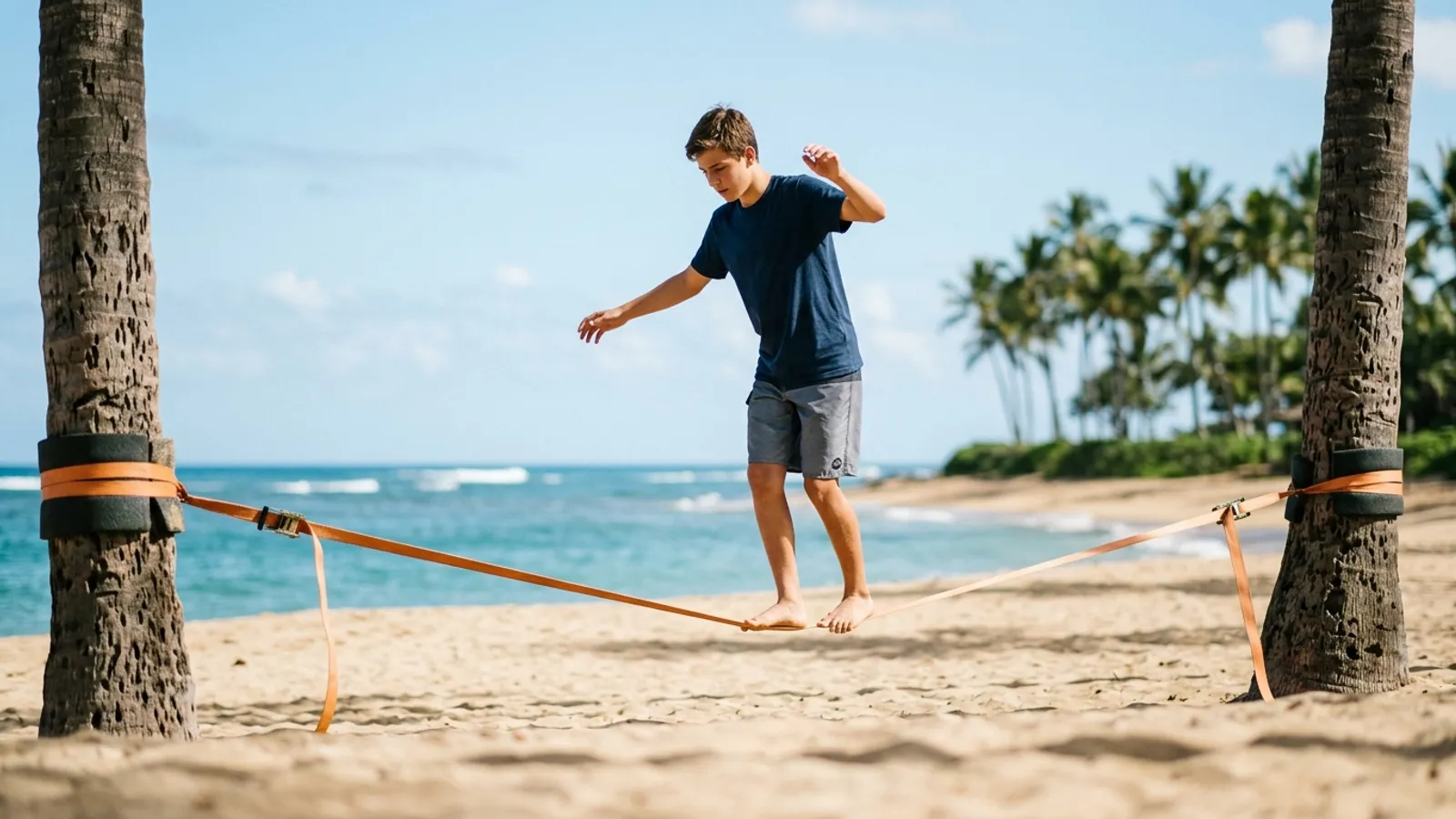
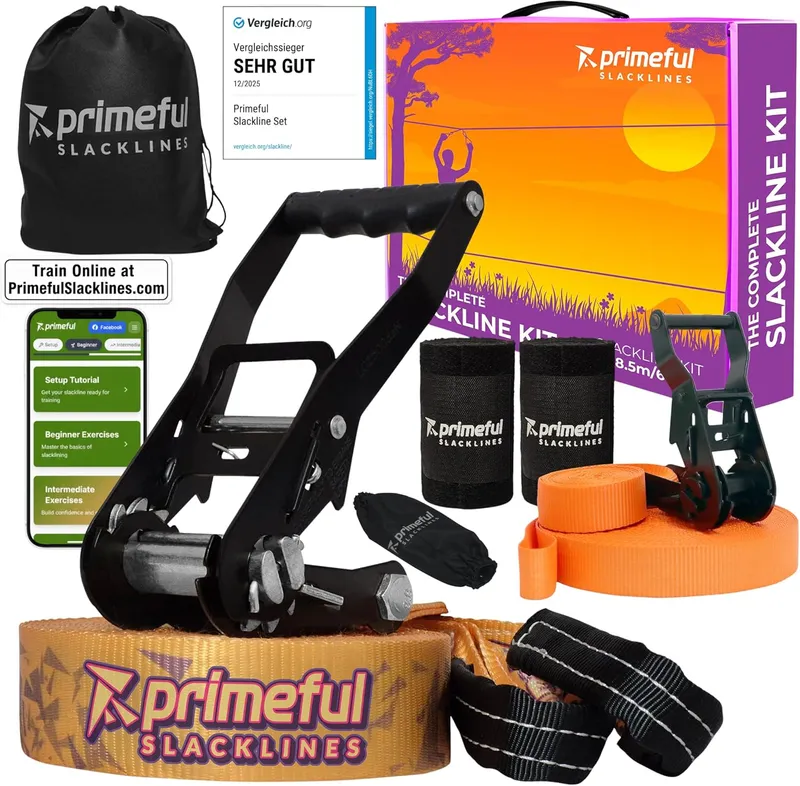
Primeful slackline set with training line
A robust set for indoors and out — ideal as a mobile balance tool for sport-specific training.
Slackline cross-training is the smart complement for anyone who wants to get better at their sport outdoors. The line trains exactly what climbers, skiers and surfers need: fine balance, an alert core and a lightning-fast reaction on unstable ground. Instead of only working on machines, on the webbing you train the connection between perception and movement — and that transfers directly to rock, slope and wave. Best of all: you need neither much space nor much time for it.
Why cross-training on the line works
Every sport with a balance component thrives on proprioception — your body’s ability to control joint position and balance without looking. That’s exactly the ability the slackline demands every second. Because the band keeps giving way, your feet, hips and core have to counter constantly. This micro-training strengthens the deep supporting muscles and shortens your reaction time — both worth their weight in gold when a foothold breaks away or the wave tips.
The second advantage: the line is mobile and easy on the joints. There are no hard impacts like in jump training, just soft, controlled movements that spare your joints. You take it to training camp, tension it for warming up and round out your slackline training without any heavy equipment. If you haven’t mastered the basic stand securely yet, pick it up first in the slackline fitness guide; our setup guide shows you the right setup.
Slackline cross-training for climbing
Climbers benefit twice over: better footwork and a stable core for moves on the wall. If you can stand securely on the line, you’ll also trust the small footholds on rock more — because your nervous system has learned to call up fine corrections automatically. These drills bring out exactly that.
Precise single-leg stand
Stand on one leg on the line and hold for 20–30 seconds, then switch legs. This trains the fine footwork you need for small footholds on rock.
What to watch: Tension comes from the standing leg, not from clenched toes.
Reach & Hold
Stand stable and slowly reach one hand far forward and to the side, as if reaching for a hold. Hold the position briefly, then return in a controlled way.
What to watch: Keep the hips still — only the arm moves.
High step on the line
From standing, slowly draw one knee up to hip height and lower it again without wobbling. This simulates the high step and strengthens hip stability.
What to watch: Lift the knee actively, keep the upper body upright.
For skiing, snowboarding and winter sports
On skis and a board, dynamic balance is decisive: shifting weight, absorbing bumps, staying stable through the turn. The line simulates that surprisingly well — and keeps you fit for your next season highlight during the snow-free months.
Dynamic squat
Lower into a controlled squat on the line and rise back up. This trains leg tension and shock absorption for uneven terrain.
What to watch: Deep into the knees, chest upright — like a downhill tuck.
Lateral weight shift
From standing, shift your weight rhythmically from left to right, as if carving turns. That transfers the feel for clean, controlled turns.
What to watch: Steer the movement from your centre, not from your arms.
For surfers and board sports
Surfing, SUP and skateboarding demand rotational stability and a good feel for the centre of the board. On the line you practise that on dry land and repeat it as often as you like: slowly turn into the surf position from standing, hold low and steady, and work on soft compensating movements from the knee and hip. If you like, close your eyes for a few seconds — that takes control away from the eye and clearly increases the stimulus for your proprioception.
What matters is the quality of the movement: slow and clean beats hectic. Your goal isn’t to stay up as long as possible, but to consciously feel the micro-corrections. These drills are no substitute for the water, but they’re an ideal preparation for the days when there’s no wave — and a good warm-up right before a session. Deliberately switch the direction of rotation so that both sides are trained evenly; in the water that symmetry pays off noticeably. Pause briefly between attempts and notice how calm your stance has already become.
Your weekly cross-training plan
Here’s how to build the line sensibly into your sports week without overloading yourself. See the plan as a suggestion you adapt to your main training:
| Day | Focus | Duration |
|---|---|---|
| Mon | Activation & single-leg stand | 10 minutes before strength training |
| Wed | Sport-specific drills | 15 focused minutes |
| Fri | Dynamics & weight shift | 10–15 minutes |
| Sun | Easy & eyes closed | short, relaxed session |
Important: quality over duration. Short, focused sessions do more than long, tired practice — and slot easily into your existing programme. Schedule the line before intense strength sessions while your nervous system is still fresh. That way you get the biggest transfer without slowing down your main training.
What matters for transfer
For the training on the line to truly carry over into your sport, the way you practise counts more than the sheer time on the band. Three principles make the difference. First: stay specific. Choose drills that resemble the movement in your sport — a climber benefits from the single-leg stand and reach, a skier from dynamic squats and weight shifts. Second: feel consciously. Pay attention to the small corrections in your foot and hip rather than just counting seconds — it’s exactly that awareness that later transfers to the terrain.
Third: train regularly and fresh. Schedule the line in short sessions, ideally at the start, when your nervous system is still receptive. Tired repetitions at the end of a hard session do little and tend to grind in sloppy patterns. And be patient: balance is a skill that grows over weeks, not overnight. If you stick with it, you’ll often notice the difference first where you least expect it — in a more stable standing phase, a calmer landing or a more secure foothold.
One last tip: vary the conditions now and then. A slightly longer line, softer ground or closed eyes force your body to find new solutions and keep the stimulus high. That keeps your cross-training varied — and effective.
Frequently asked questions
Does slackline cross-training replace my normal training?
No. It complements your sport-specific training and strength work with targeted balance and core stability — as a warm-up or as a short session of its own. Your main training stays the foundation.
How often should I train on the line?
Two to three short sessions a week are enough to get a noticeable transfer to your sport. More is allowed, but not necessary — regularity beats duration.
Do I need a special slackline for this?
No. A stable beginner line is enough. Tension it low and use it as a mobile balance tool — with a tree or a frame, indoors and out.
From what level is cross-training worth it?
As soon as you can stand securely on both legs on the line. You build the basic stand in a few sessions; after that you can start the sport-specific drills right away.
Take your balance to the next level — the line is your mobile training partner.